

Why the cost of your AI agents may exceed the cost of an employee
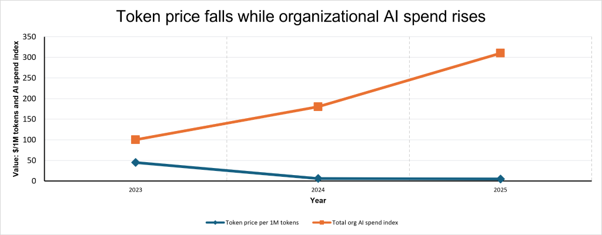
The prevailing logic in most executive conversations about AI automation is that it's fundamentally cheap. Tokens cost fractions of a cent, models improve every quarter, and deploying more AI tools for the business should mean lower overall spending. Token prices have fallen, but total AI spending is rising in most organizations. Usage is increasing faster than unit costs decrease, and many organizations still estimate costs based solely on LLM usage, which is insufficient for AI agents.
The real cost of AI agents goes far beyond the price of tokens. In a February 2026 episode of The All-In Podcast, host Jason Calacanis shared that some AI agents can reach $300 per day per agent when using Anthropic’s Claude API. Even if that agent is used only 10% to 20% of the time, the annualized cost could approach $100,000 per agent.
AI is extremely expensive to run at scale and AI vendors are under increasing pressure to deliver on the financial returns promised in order to secure the massive investments they have made to build their solutions. Vendors are increasingly passing their development costs on to customers through consumption tiers, outcome-based pricing, and blended contracts. And the total cost of running an AI agent for business process automation goes far beyond inference costs, encompassing infrastructure, orchestration, human oversight, bug fixes, governance overhead, and ongoing maintenance. Organizations that don't account for all of these stages are underestimating their AI costs.
This article maps the full picture of the cost of the AI agents. It starts with the cost illusion, explaining why cheaper tokens are producing higher bills, then breaks down the components of agent cost, including training costs, inference costs, and context window overhead that most estimates overlook. It then introduces a practical framework for understanding when AI automation generates savings and when it does not, and explains why most organizations lack the visibility to answer that question today.
Summary of key concepts
The Cost Illusion: Cheaper Tokens, Higher Bills
The paradox at the center of enterprise AI automation economics is that while the price of a token keeps falling, the total cost of keeping AI running continues to rise. Understanding why is the first step toward governing it.
When tokens were expensive, organizations were naturally conservative, one prompt, one task, one interaction at a time. Teams began building more ambitious systems, such as context-heavy agents that load entire knowledge bases into each call, automated workflows that chain multiple model interactions together, and background processes running without anyone watching. The marginal cost of a single query feels negligible, so consumption expands to fill available capacity.
The result is that lower unit prices do not automatically lead to lower total bills. Instead, they lead to higher consumption.
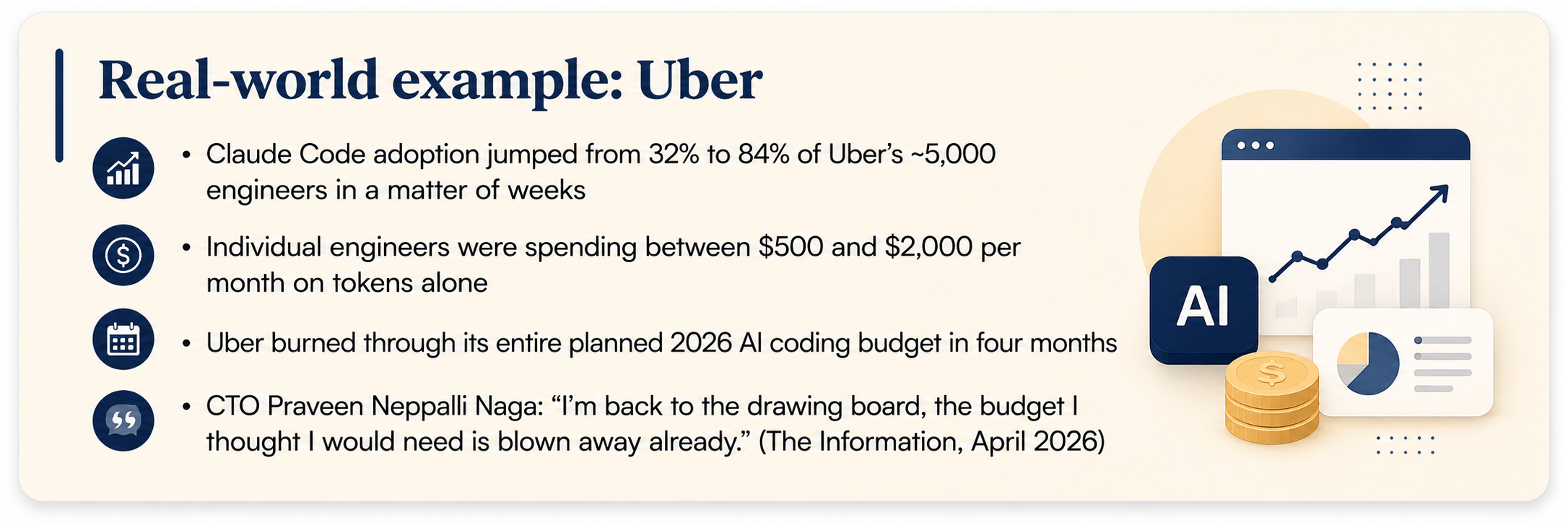
Microsoft deployed Claude Code to thousands of engineers, product managers, and designers across its Experiences and Devices division, the group that builds Windows, Office, Teams, and Surface. Six months later, it cancelled most of those licences. The official reason was toolchain unification. The timing, at the close of Microsoft’s fiscal year, told a different story. When the world’s largest software company, one that builds its own AI models and coding tools, walks away from a product its own staff preferred, the signal is not about strategy. It is about the invoice.
Nvidia’s VP of Applied Deep Learning, Bryan Catanzaro, made the same point from a different vantage point: for his team, the cost of compute now exceeds the cost of the employees using it. A 2024 MIT analysis reached a complementary conclusion on current pricing, that AI automation pencils out as cheaper than human labour for roughly a quarter of the jobs it was expected to replace, not the majority.
What Actually Drives AI Agent Cost
The per-token price is only the most visible part of the cost structure. The factors that actually determine what an organization pays are:
- Agent loops - each autonomous action an AI agent takes triggers new model calls. A single task involving planning, tool use, verification, and output generation may require a dozen or more individual calls.
- Retrieval and tool use - Every time an agent retrieves context from a document store, queries a database, or calls an external API, it adds to both token consumption and infrastructure cost.
- Always-on behavior - background agents running in AI process automation pipelines consume tokens around the clock, regardless of whether anyone is actively monitoring their output.
- Error and retry cycles - when an agent produces an incorrect or incomplete output and retries, the failed attempt still costs money. High error rates compound rapidly at scale.
AI as Partner, Not Replacement: The Case for Augmentation
The organizations paying the highest AI bills are often the ones that treated deployment as replacement, swapped the human, reduced the headcount, and pocketed the savings. The organizations seeing the best returns are the ones that treat deployment as augmentation, give people better tools, extend their capabilities, and let them do more in the same time.
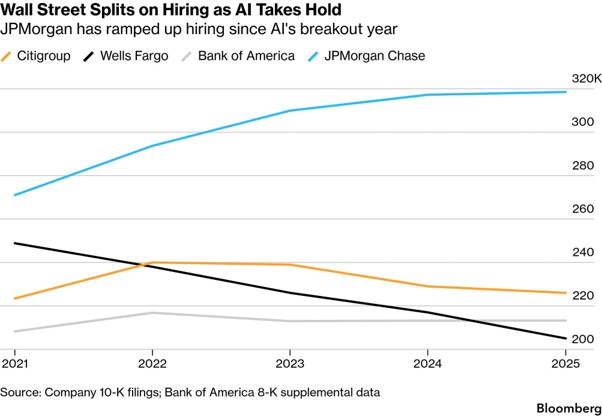
The Bloomberg data on Wall Street hiring patterns makes the point concretely. JPMorgan Chase, which has deployed its LLM Suite generative AI tool to most of its employees and is building AI agents for financial services tasks, including drafting pitch decks and reviewing financial statements, has simultaneously grown its workforce from approximately 265,000 to over 315,000 people since 2021. Wells Fargo, which took a different approach, has shrunk from roughly 250,000 to under 200,000 over the same period. The firms treating AI as augmentation are expanding. The firms treating it as a substitute are contracting.
Some Wall Street firms are paying consultants as much as $25,000 a day to teach their bankers how to use AI tools not to replace their judgment, but to extend it. The investment thesis is that a banker augmented by AI is worth significantly more than a bank with fewer bankers. The cost of that augmentation, including the training, the tooling, and the governance, has to be accounted for honestly. But the direction of travel is clear.
Core Components of AI Agent Costs and Employee Costs
AI agents do not replace the need for human judgment; rather, they change the way that judgment is applied. In practice, implementing automation through AI means using agents alongside employees, which creates a combined cost structure that must be understood and managed as a whole.
The most relevant question is not whether an agent is cheaper than a person, but rather how much it costs to operate AI systems when human oversight, validation, and exception handling are factored in, and whether that total cost is proportional to the value generated.
Most organizations compare this quarter’s AI costs to last quarter’s, compare token prices with those of competing vendors, or measure AI spending relative to the overall software budget. While these comparisons have their place in procurement discussions, they overlook the cost components that truly determine whether an AI investment is delivering results.
The Total Cost of AI
A comprehensive calculation of what it costs to run AI agents in an enterprise environment must include the infrastructure and orchestration layer that manages agent execution across the automation stack, the human oversight required to review and validate results, the cost of correcting AI-generated content that turns out to be incorrect or incomplete, and the ongoing investment in prompt engineering, model updates, and maintenance that keeps agents accurate over time. Overhead costs for governance, regulatory compliance, and auditing add another layer that rarely appears in initial business cases but steadily accumulates as deployments scale.
The Total Cost of Human Side
The human aspect of the equation demands the same rigor. Hiring and onboarding costs, general management expenses, and lost productivity during the ramp-up phase are just as real and just as easy to overlook in an initial calculation. When agents are deployed alongside employees rather than replacing them, the cost of coordination between the two must also be taken into account, including who reviews what, who escalates when, and who is responsible for the outcome.
When both aspects are evaluated fully and honestly, the combined cost of managing AI agents and the people working with them is often significantly higher than the nominal price alone would suggest.
Three Cost Regimes: When Agents Win, Break Even, or Lose
The Governance Gap: Why Most Organizations Don't Know Their Agent Costs
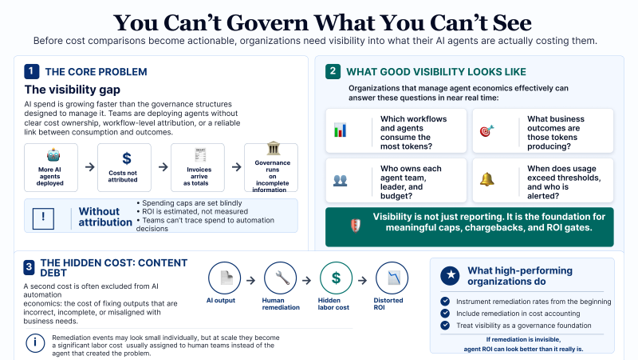
AI spending is growing faster than the governance structures designed to manage it, as teams create and run agents without clear cost allocation, attribution to specific workflows, or any way to link consumption to outcomes. Organizations that effectively manage AI data analytics and agent economics can identify, in near real time, which workflows are driving consumption, which outcomes those tokens are generating, and when spending exceeds a threshold.
Every AI outcome that requires human review, correction, or rework is absorbed by the human teams making the corrections, making agent costs and human productivity appear lower than they actually are. At scale, content debt can distort the return on investment (ROI) analysis of an entire implementation. Tracking correction rates from the outset is what differentiates organizations that detect it early from those that discover it too late.
Practical Governance: What Actually Works
These problems, such as uncontrolled pilot projects, unexplained token invoices, fragmented deployments without a shared responsibility model, and ROI cases based solely on token price, constantly arise in automation consulting projects. They are the norm for most organizations during the first two years of a significant AI automation investment.
The Daita Solution works with organizations at the point where AI automation ambition meets cost reality. Our engagements are designed to move clients from unmanaged AI spend to governed, accountable AI operations, building the infrastructure for visibility, attribution, and financial discipline that allows AI tools for business to scale without cost surprises.
Where Clients Typically Are When They Come to Us
• AI automation pilots are live, but there is no reliable visibility into what they cost, whether they are working
• Token bills are growing quarter over quarter, and no one can explain which business process automation workflows are driving it
• Business units are deploying agentic AI independently with no shared governance model or cost accountability
• The ROI case for AI in business was built on token price alone; the fully-loaded cost picture does not exist
What We Do
The Daita Solution focuses on three levels of AI automation: governance cost visibility, governance design, and agent accountability.
In practice, this means mapping the actual destination of AI spending by workflow, not by software seat or departmental budget, which often masks the true cost of the project. This enables customers to clearly visualize their cost structure for the first time.
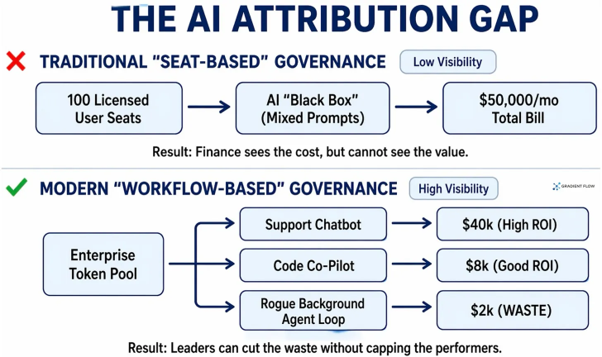
It means designing accountability structures (token budgets, FinOps practices, cost impact assessments etc), review cycles, and escalation channels that prevent cost over runs in intelligent automation deployments. It also means creating comprehensive cost comparisons that enable customers to make honest decisions about where AI automation delivers value and where it doesn't. This includes advising on the appropriate infrastructure choices for the use cases and developmental cycle. And finally, it means connecting AI automation spending to existing financial governance frameworks so it's managed with the same rigor applied to cloud infrastructure, software acquisition, or capital investment.
Conclusion: The New Cost Stack
The belief that AI in business is cheap due to low token costs is no longer a sound basis for strategic decisions. Cheap tokens, multiplied by high trading volumeand AI with always-on agents, generate significant operating costs. Add to thisthe overhead of governance, bug fixes, human oversight, and content debt, and the total cost of deploying AI a long side the workforce is closing the gap with traditional operating models faster than most organizations expect. For some workflows, this gap has already closed, and for some others, the combined cost of the agent plus oversight already exceeds the cost of traditional manual processes, and the organization is unaware of it.
The starting point is understanding the true cost of each AI agent, including all costs, not just at the token level, because decisions based on partial cost information produce, at best, partial results. The next step is to conduct an honest comparison, including oversight and bug fixes, rather than comparing a token price to a salary and calling it analysis.
Beyond measurement, the organizations that will truly benefit are those that establish governance before scaling intelligent automation, not after. Adapting accountability to an already scaled implementation is significantly more costly in time and money and generates more organizational friction than designing it from scratch. Furthermore, the economics of AI-powered automation should be viewed as a competitive risk rather than an additional expense. Organizations that govern effectively will build a structural cost advantage that will multiply over time. Those who don't will eventually have to close that gap under pressure, which is always the most difficult way to achieve success.
The true power of AI lies not in replacing humans, but in working alongside us to achieve what neither can do alone.
Sebastian Thrun, AI pioneer

Chuka Christopher Ilochi
As organizations scale AI agents, the real question is no longer what automation can do, but what it truly costs to run.
Work with The Daita Solution to uncover the hidden economics of your AI-leveraged automation before costs outpace governance.
About The dAIta Solution
The dAIta Solution provides strategic consultancy, process and data mining, analytics, reporting and automation implementation solutions powered by AI that enable organizations to achieve their full potential hidden within the information that they possess. Our proprietary mining and analytics techniques and vendor-agnostic AI and data software streamlines the path to results and facilitates automation of both the analysis of your organization and implementing solutions to weaknesses or growth opportunities identified. Founded by senior consultancy services executives, data scientists and former EY leaders, The dAIta Solution is headquartered in Los Angeles with operations in London, Lagos and Singapore. For more information, please visit thedaitasolution.com.
Latest Resources



Want to see The dAIta Solution in action?
Get in touch now for a free demo of the platform, our products and services