

Most companies begin their AI journey by asking whether a process can be automated with AI, when the most important question is whether the data underpinning that process is reliable enough to allow for automation. This distinction may seem subtle, but it explains why so many promising AI initiatives never make it past the pilot phase.
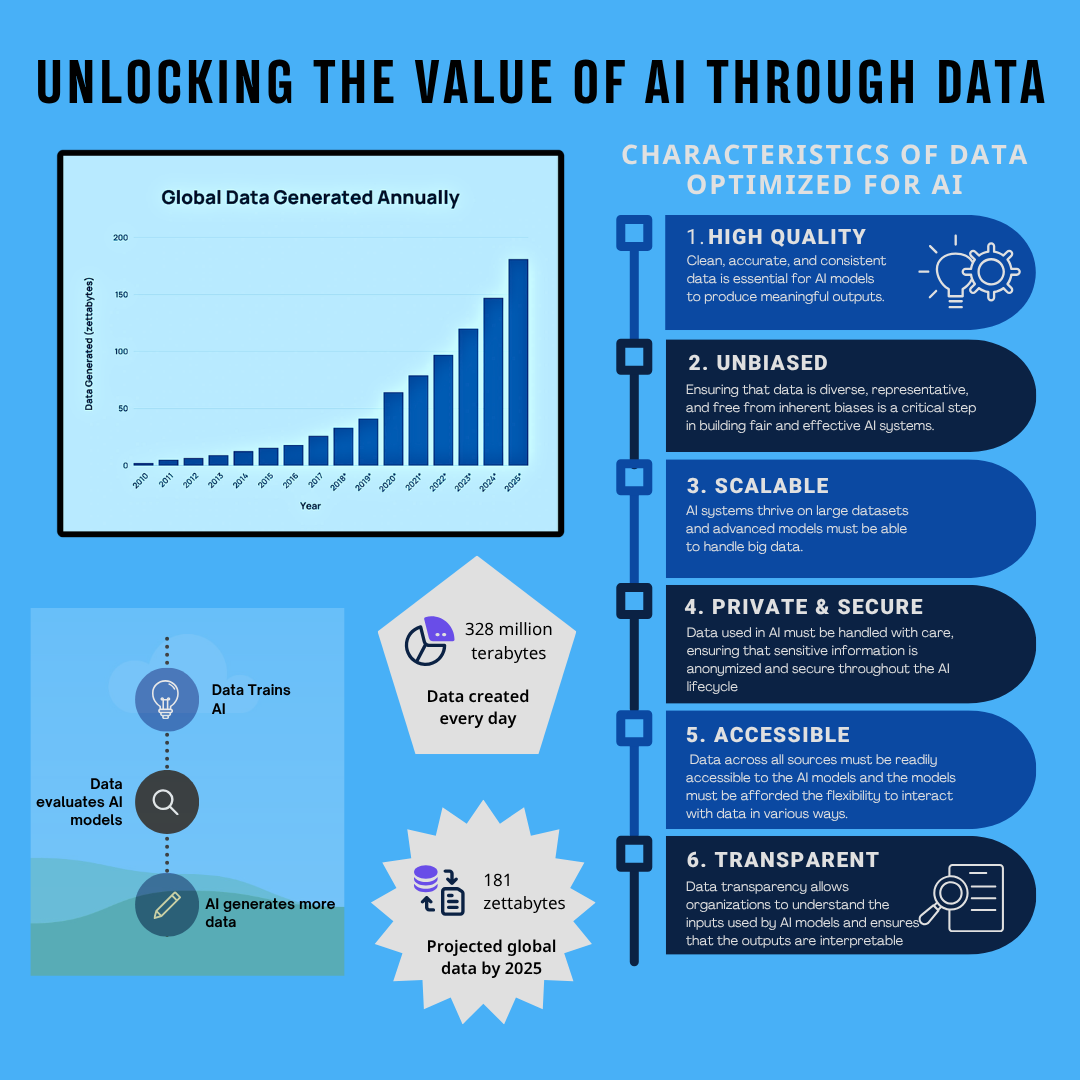
Consider a company that wants to automate customer service ticket routing using AI. In theory, the use case seems straightforward, but in practice, ticket categories are inconsistent across teams, customer information is scattered across disconnected systems, and historical resolutions are incomplete or mislabeled. Even if the AI model works well in a controlled pilot, automation is likely to fail at scale when the data supporting the workflow is unreliable, incomplete, or uncontrolled.
That's precisely why the order of the questions is crucial. Before asking whether a process can be automated with AI, organizations should take a step back and consider something more fundamental: Is the data underpinning that workflow robust enough to support large-scale automation? In most cases, an AI initiative doesn't stall because the model itself is flawed, but because the data flow is scattered across different systems, poorly maintained, difficult to access, or simply doesn't reflect how the workflow actually works on a daily basis. Once you begin to closely examine how data and AI interact in a real-world business environment, and not just in a presentation, it becomes clear that this understanding is the fundamental starting point for creating automation that works correctly once implemented.
Summary of Key Concepts
Good Reporting Data Is Not Always AI-Ready Data
A company can have clean dashboards, accurate KPIs, and impeccable executive reports, yet still lack data ready for AI automation. Report data is typically structured to explain what has already happened, such as last quarter's revenue, last month's churn rate, or last week's conversion figures. AI systems, on the other hand, need data that can support decisions, predictions, recommendations, or actions within a continuous, real-time workflow.
Data quality refers to whether data is accurate, consistent, complete, and usable for general business purposes. Data that works perfectly for a monthly report may not work for an automated recommendation engine or a real-time routing system, as these two use cases have very different tolerances for latency, granularity, and edge cases.
AI systems, particularly those based on predictive analytics and automated decision-making, need data that reflects real-world patterns, exceptions, outliers, business rules, and operational context, not a simplified summary of that context. AI readiness also depends on factors rarely displayed on a dashboard, such as metadata quality, provenance, access controls, ownership, governance, and monitoring. A report may appear comprehensive, but it can mask precisely the kind of inconsistency that will cause an automated system to fail.
Signs Your Data Is Not Ready for AI Automation
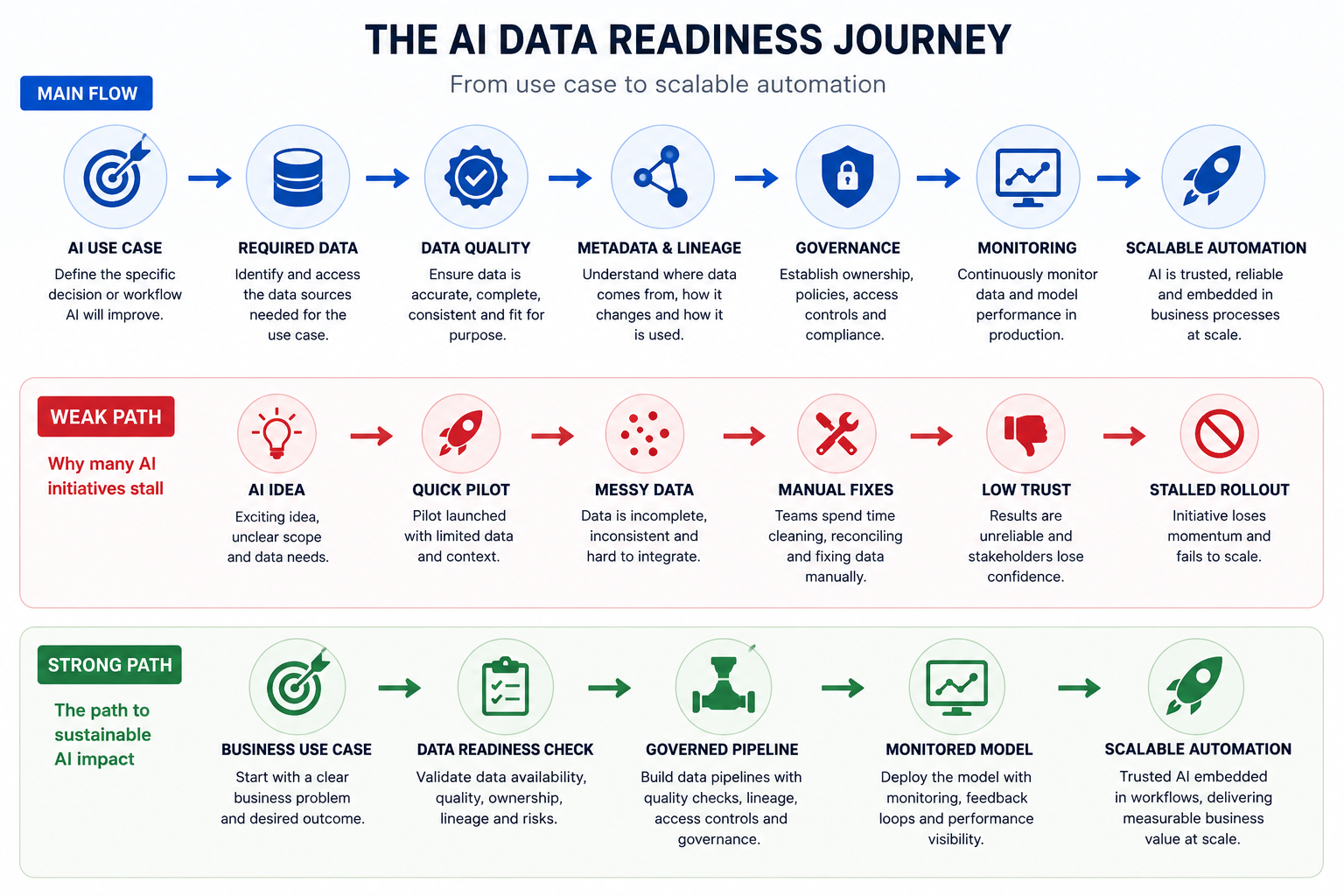
Instead of relying on abstract language about data maturity, it’s helpful to look for operational symptoms that executives and teams can immediately recognize. In practice, your data is likely not ready for AI automation if the organization can’t clearly explain where its critical data comes from, who owns it, how up-to-date it is, or whether it means the same thing across all the systems that use it.
Data is scattered across disconnected systems, such as CRM, ERP, spreadsheets, support tools, financial platforms, and marketing systems, without a single source of truth connecting them. Different teams define the same metric differently, so a term like “active customer” or “resolved ticket” means something slightly different depending on who you ask. As a result, reports don’t match, and teams end up spending hours each month manually reconciling figures that should already be consistent.
Ownership is often equally confusing, with no one clearly accountable for critical fields, datasets, or quality thresholds. This means that when something goes wrong, there's no obvious person responsible for fixing it. Metadata is incomplete, outdated, or completely static, so teams can't quickly verify the origin, currency, or context in which data was originally captured. Quality controls, when they exist, are typically performed after problems arise, rather than being integrated into the workflow itself. Sensitive data is frequently used in AI workflows before it has even been properly classified.
Legacy systems further exacerbate the problem, often storing critical information in formats that are difficult to integrate with modern analytics or AI tools. Meanwhile, employees often know the actual business rules, exceptions, and decisions that need to be made, but that knowledge is rarely documented within the data systems themselves. These shortcomings are not unusual. According to the 2023 Foundry AI Priorities Study cited in Data Holds the Keys to AI - Why and How to Unlock Value, 48% of respondents identified data quality and quantity issues as significant barriers to implementing GenAI solutions.
The Consequences of Poor Enterprise Data
“Gartner predicts that through 2026, organizations will abandon 60% of AI projects unsupported by AI-ready data.”
- Gartner, STAMFORD, Conn., February 26, 2025
Inadequate data is not just a technical oversight; it carries real business cost. The visible cost of bad data is wasted budget on tools, models, and pilots that never make it to production. The less visible cost is slower decisions, duplicated work, compliance exposure, and AI systems that simply cannot survive contact with real operations.
Poor data quality creates rework, slows down decisions, produces inconsistent reporting, and erodes trust across teams. Weak data governance makes even a promising AI pilot difficult to scale, because the controls, ownership, and monitoring needed for production simply aren't in place. AI has a way of amplifying bad data, since automation spreads errors far faster than a human ever could. A pilot can look impressive in a controlled environment and still fail once it hits production, if the data pipeline behind it is unstable. Over time, when teams cannot trust the data, they eventually stop trusting the automation built on top of it, and adoption quietly stalls.
Why Some AI Pilots Look Good but Fail to Scale
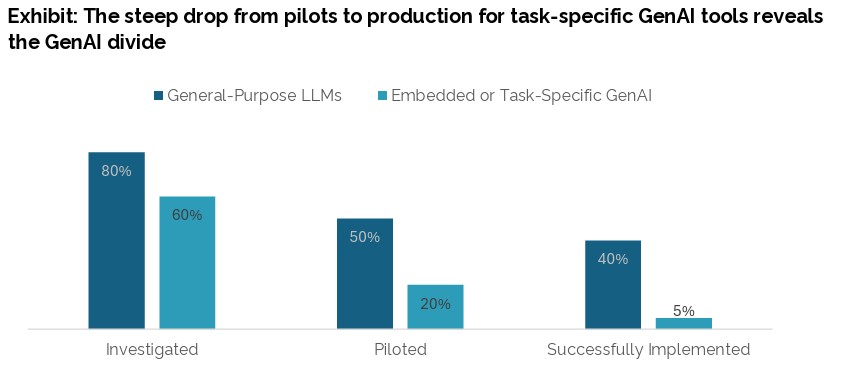
The pilot-to-production gap is especially visible in task-specific GenAI tools. According to MIT NANDA’s State of AI in Business 2025 report, while 60% of organizations investigated embedded or task-specific GenAI tools and 20% piloted them, only 5% successfully implemented them. This gap shows why AI readiness cannot stop at experimentation: organizations need reliable data, governance, workflow integration, and monitoring to move from pilot to production
An AI pilot project can succeed in a controlled environment precisely because the underlying data has been carefully selected, refined, and limited in scope. Production is a completely different world. In production, data is constantly changing, unforeseen exceptions arise, users interact with the system in unexpected ways, and governance requirements become considerably more stringent. A pilot project is typically run with a small sample of data, while production requires constant access to real-time, dynamic, and often messy operational data.
That's why AI systems need continuous monitoring as data patterns change over time, and a model that worked well six months ago can silently degrade as the underlying data evolves. Governance becomes even more critical as AI transitions from a support tool to a true decision-making layer within the enterprise. In most cases, the real hurdle isn't model performance, but rather the integration of the workflow and the underlying data infrastructure.
What AI-Ready Organizations Do Differently
The organizations that consistently get real value from artificial intelligence in business tend to do the unglamorous things well first. They define the use case clearly, clean the inputs, assign ownership, document context, monitor quality continuously, and build trust in the pipeline before scaling anything.
In practice, this means starting with a specific business decision or workflow rather than a generic AI ambition, and then mapping the exact data inputs that use case will need. It means identifying data owners before deployment, not after something goes wrong, and defining quality thresholds early enough that everyone agrees on what "good data" actually means for that use case. It means tracking lineage, freshness, and access on an ongoing basis, classifying sensitive data before it ever reaches an AI workflow, and building monitoring directly into the pipeline rather than treating it as an afterthought.
These organizations also treat metadata as an active operational layer rather than static documentation, and they redesign the workflow around how AI will actually be used day to day, not around how it looked in a demo. They scale only after proving the system works reliably in real operations, and they establish clear AI and data governance to define ownership, controls, risk management, compliance, and accountability from the start. Just as importantly, they use governance tools or frameworks to assess readiness, document controls, and align every AI initiative with business and regulatory requirements, treating decision intelligence as a discipline rather than a byproduct of the technology.
The Daita Solution’s AI Governance Toolkit gives organizations a structured way to assess whether their data, policies, controls, ownership, and monitoring practices are ready to support AI safely and at scale.
Mini-Framework: The AI Data Readiness Test
Before selecting a tool, model, or vendor, it helps to run a simple internal diagnostic. The framework below is designed to surface gaps that often only become visible once a project is underway, giving teams a practical way to evaluate readiness across data and AI together rather than treating the model as the only variable that matters.
This is where The Daita Solution’s AI Governance Toolkit can help. Rather than treating governance as a final compliance step, the toolkit gives organizations a structured way to assess whether they have the right foundations in place before scaling AI. This includes a trusted data readiness checklist and practical frameworks to review approved AI tools, data access controls, sensitive data use, evaluation datasets, accountability, monitoring, audit trails, and review cadence.
Closing Thoughts
AI automation is only ever as strong as the data foundation behind it. Before scaling any AI initiative, organizations need to validate whether their data is reliable, governed, accessible, and genuinely aligned with the workflow they are trying to improve. This is true whether the goal is customer support automation, predictive analytics AI, or a broader push toward using AI in business across multiple departments.
AI can accelerate decisions only when the data behind those decisions is stable enough to earn trust.

Is Your Data Ready to Support AI at Scale?
Before expanding AI automation, assess whether your data, governance, controls, and workflows are ready for production.

About The dAIta Solution
The dAIta Solution provides strategic consultancy, process and data mining, analytics, reporting and automation implementation solutions powered by AI that enable organizations to achieve their full potential hidden within the information that they possess. Our proprietary mining and analytics techniques and vendor-agnostic AI and data software streamlines the path to results and facilitates automation of both the analysis of your organization and implementing solutions to weaknesses or growth opportunities identified. Founded by senior consultancy services executives, data scientists and former EY leaders, The dAIta Solution is headquartered in Los Angeles with operations in London, Lagos and Singapore. For more information, please visit thedaitasolution.com.
Latest Resources



Want to see The dAIta Solution in action?
Get in touch now for a free demo of the platform, our products and services