
From SEO to AI Search Visibility: The New Rules of Digital Discovery
AI is reshaping how customers discover, compare, and choose businesses. Learn why visibility now depends not only on ranking, but on being understood, trusted, and cited by AI systems.

From SEO to AI Search Visibility: The New Rules of Digital Discovery
Artificial intelligence in business is becoming an operational layer that spans finance, operations, human resources, customer service, product development, sales, and marketing. No sector remains untouched by this phenomenon. Within marketing, one shift stands out especially.
For nearly 30 years, companies have competed to appear on Google’s first page; this has allowed them to secure better positioning, attract more clicks, and generate more leads. An entire industry was built around mastering that logic, but AI has changed how people discover, evaluate, and choose, shifting the point of influence away from the search results page entirely.
Users no longer need to click on ten links to find what they are looking for. They ask a question in natural language, receive a synthesized answer, and often make decisions without ever visiting a website. Customers now ask AI platforms for recommendations, comparisons, explanations, use cases, and vendor options before they ever reach a company’s website.
If an AI answer mentions your competitors but omits your business, the buying journey may start without you. The customer's first impression has already been shaped by sources the AI system trusts more.
The real risk is that this loss of visibility may not appear in traditional analytics. There may be no lost clicks, no drop-off session, and no clear attribution path. The customer was simply guided elsewhere before your website had the chance to influence the decision.
How AI Is Changing Marketing
This represents the most consequential shift in AI and marketing in a generation. Artificial intelligence in marketing is no longer a niche discipline; it is reshaping how companies get discovered, build trust, and influence decisions at every stage of the funnel. AI has changed the underlying logic of how companies are discovered, how they build trust, and how they influence decisions. The rules governing digital marketing are being rewritten, and companies that recognize this early will gain an advantage over those that wait.
Marketing is shifting from traffic to trust
For years, the central question in digital marketing was: "How do we get users to click?" Every strategy (keywords, ad spend, page speed, meta descriptions) was built around securing that click.
AI systems are designed to synthesize accurate, credible answers. This means they favor brands with genuine authority as companies that are cited, referenced, reviewed, and discussed across multiple independent, trustworthy sources. A company might outspend its competitors on content yet remain absent from AI-generated answers if the underlying trust signals are weak.
Public relations is becoming part of SEO
One of the most significant structural changes in AI-driven marketing is the convergence of public relations and search optimization. Historically, these were separate disciplines with distinct budgets and teams.
AI models determine brand credibility by looking at what the web says about a company, not just what the company says about itself. Mentions in publications, industry directories, reviews, interviews, podcasts, Reddit threads, and third-party platforms now serve as trust signals that influence how AI understands and describes your brand.
In practical terms, securing a mention in a credible industry publication or receiving a review on a respected platform provides direct input for the information AI uses when deciding whether to cite you.
Analytics no longer tell the whole story
Traditional marketing analytics rely on the premise that if something matters, it will eventually manifest as a website visit or a conversion. One of the most disorienting AI use cases in digital marketing is invisible influence; AI can influence decisions without generating website traffic. A user might ask ChatGPT which marketing agency to hire, receive three competitor names, and build a shortlist, all without visiting a single website. That interaction is invisible to standard digital marketing analytics tools; Google Analytics, Search Console, and traditional SEO platforms were not built to capture AI-mediated influence. New marketing analytics tools that track AI citation frequency and share of voice are only now beginning to emerge.
How AI Has Evolved Digital Search - The Technical Shift
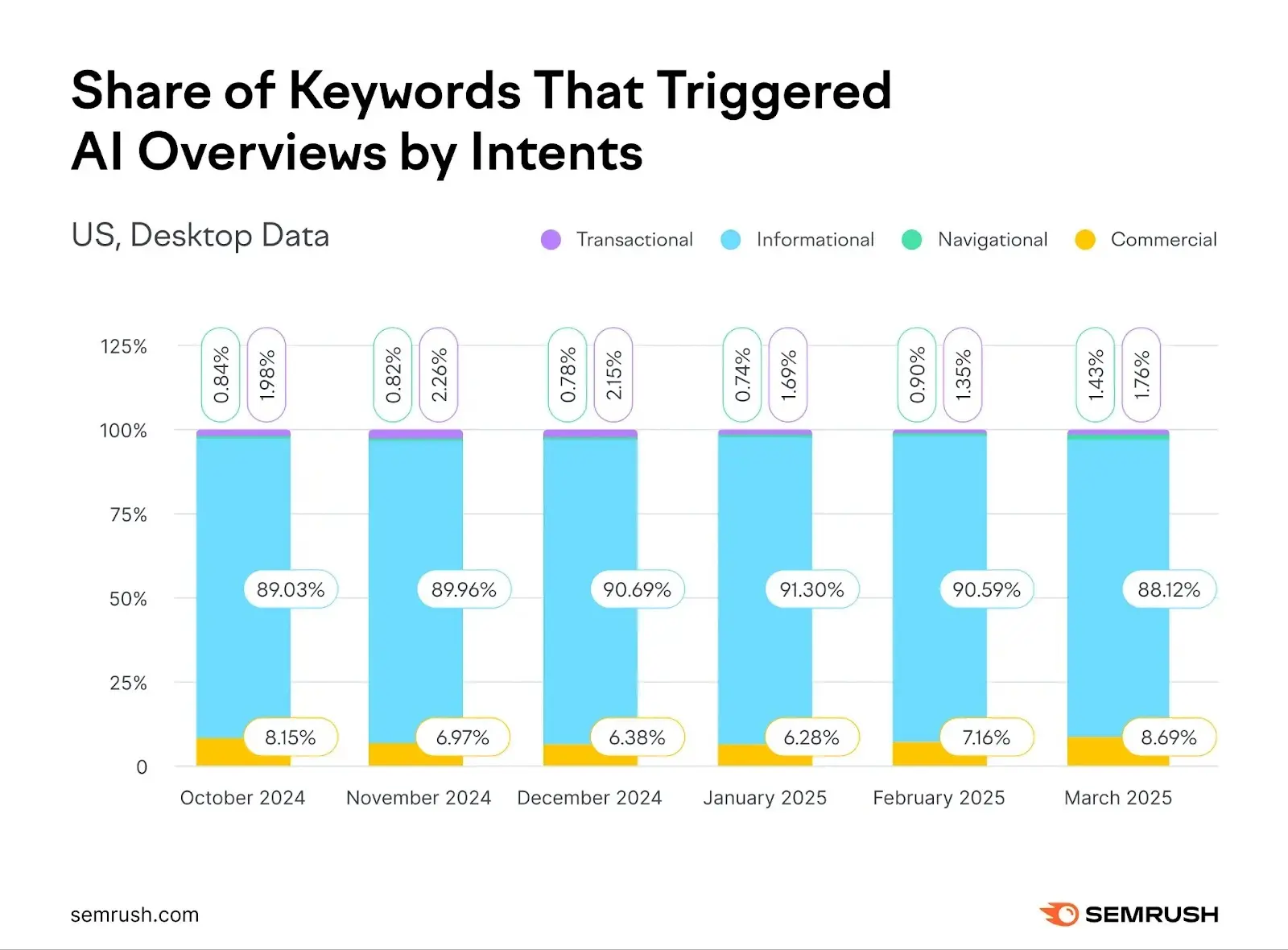
To understand why marketing strategy needs to change, it is important to understand what has changed technically. The transition from traditional search to AI-generated answers is not just a new interface. It is a different retrieval and synthesis architecture.
Traditional search engines crawl, index, rank, and display links. AI-powered search systems retrieve information, analyze snippets, assess semantic relevance, synthesize multiple sources, and generate a result. This changes the meaning of visibility, as a page not only needs to rank well; it must be accessible, machine-readable, semantically clear, and useful enough to be selected as a source of information.
From Links to Answers
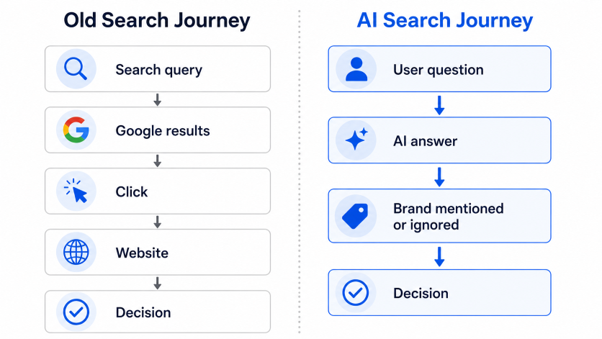
In the traditional search model, a user searched for a keyword, reviewed a list of links, clicked on a result, and visited a website.
In AI search, the user asks a complete question in natural language and receives a synthesized answer. In many cases, the user never even visits a website. This means that the website is no longer just a traffic destination but becomes an input layer for AI systems.
This shift makes technical accessibility more important. If a website blocks AI crawlers, uses weak semantic markup, hides key content behind scripts, or structures pages in a way that makes them difficult to analyze, the content may never reach the retrieval layer. AI-parsable architecture is now crucial, as AI systems need to understand not only the words on the page but also their purpose, hierarchy, authorship, relationships between entities, and thematic relevance.
From Positioning to Citation
In traditional SEO, the goal was to rank in the top organic results. In AI search, the goal is also to be retrieved, cited, summarized, or recommended inside a generated answer. This is where citation engineering becomes important. Content must be structured in extractable, self-contained passages that connect a clear claim with context, evidence, and a conclusion.
AI systems often retrieve smaller content units rather than treating the whole page as one block. A long article may contain valuable insight, but if the relevant passage is buried, vague, or unsupported, it may not be cited. By contrast, a clear paragraph with a specific answer, relevant data, source attribution, and concise framing is more likely to become usable material for an AI-generated response.
Ranking still matters, but it is no longer the full visibility equation. A company can perform well in search results and still be absent from AI answers if its content is not technically structured for retrieval, extraction, and citation.
From Keywords to Entities
Traditional SEO focused heavily on keywords and search intent. The goal was to appear when users typed specific phrases into a search engine. AI systems work more semantically. They try to understand brands as entities and connect them with products, services, categories, industries, locations, authors, competitors, reviews, and third-party references. This is why entity consistency is now a technical requirement, not just a branding exercise.
For advanced AI-powered visibility tactics to work, a solid foundation is essential, including crawlable pages, a clear site architecture, structured data, consistent brand descriptions, an entity-level schema, and content organized by topic rather than isolated keywords. If the model doesn't accurately understand what a company is, what it offers, and its market position, it could misclassify the brand or choose a competitor with stronger entity signals.
In this environment, keywords still matter, but they are no longer enough. AI visibility depends on whether the brand is semantically clear across its website, directories, review platforms, social profiles, and external mentions.
From Website Authority to Distributed Authority
Traditional SEO relied heavily on backlinks and domain authority as signals of credibility. The more reputable websites linked to a page, the more trust search engines tended to assign to it.
AI systems evaluate authority in a more distributed way. They look for consistency and credibility across multiple sources: press mentions, industry directories, review platforms, Reddit discussions, YouTube transcripts, podcasts, expert interviews, partner pages, and structured on-site content.
Research, such as Gradient Flow’s AI visibility analysis and the Princeton-led Generative Engine Optimization study , suggests that AI systems do not simply replicate traditional Google rankings when selecting sources to cite.
This means authority is no longer built only on the company’s own website. It is built across the wider digital footprint. If credible external sources describe the brand consistently, AI systems gain confidence in how to represent it. If the broader web is inconsistent, outdated, or silent, the model may rely on competitors or third-party narratives instead.
The New Alphabet: SEO, GEO, AEO, and AIO
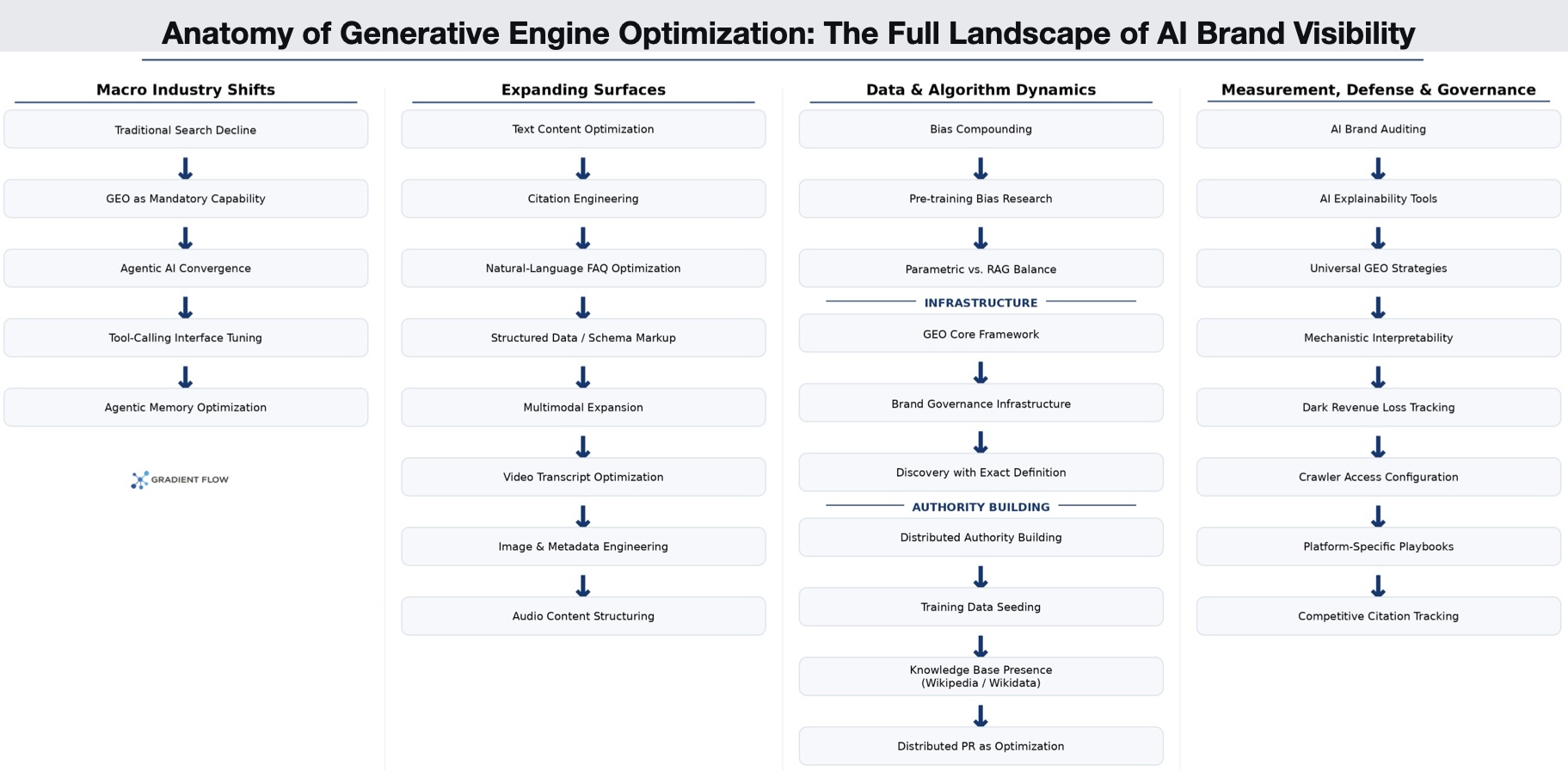
The marketing sector is adapting to this shift with a new set of terms. Although the terminology is still taking shape, the underlying concepts are distinct and well worth understanding clearly.
SEO: Search Engine Optimization
Optimizing content so that traditional search engines can crawl, index, rank, and display it in search results. SEO remains essential. It is the foundation upon which everything else is built, and AI systems still rely on many of the same signals when deciding which content to retrieve.
AEO: Answer Engine Optimization
AEO focuses on the website's structure, including FAQ sections, structured data markup (schema markup), clear headings, concise definitions, and easily extractable answer blocks. The goal is to make it easy for AI to take the content and use it verbatim or in summary form.
GEO: Generative Engine Optimization
Generative Engine Optimization is the practice of optimizing a brand to appear in AI-generated responses. Unlike traditional SEO, which seeks to rank via links, GEO aims to influence the retrieval logic and neural patterns of foundational models, ensuring that AI systems correctly select and cite a brand when synthesizing their answers.
GEO focuses primarily on off-site factors, such as brand mentions in authoritative publications, the press, Reddit, YouTube, Wikipedia, review platforms, industry directories, and reliable third-party sources.
AIO: Artificial Intelligence Optimization
AIO represents the overarching mindset, optimizing a company's entire digital presence (both on-site and off-site, and across both technical and editorial aspects) for AI systems, rather than just for traditional search engines. It encompasses SEO, AEO, and GEO as components of a unified strategy for AI visibility, applicable across all AI use cases in digital strategy.
How to Become the Answer AI Uses
The goal is not to abandon SEO. The goal is to expand it. Businesses need to make both their website and their broader digital presence useful, accessible, and credible enough for AI systems to retrieve, summarize, and cite. Here is a concrete framework for doing that.
Audit Your AI Visibility
Query ChatGPT, Gemini, Perplexity, and Google AI Overviews directly. Ask them how they describe your company, your competitors, your category, your services, and your market's purchasing criteria.
Most teams skip this step and optimize blindly. Yet, your brand might be miscategorized, fail to appear at all, or be described in ways that no longer reflect your current positioning. Identifying these issues in how you are mentioned is the prerequisite for everything else.
Business visibility tools from major search marketing platforms already enable this type of structured tracking regarding mention frequency and competitive positioning; however, even a manual quarterly audit provides a solid foundation to build upon.
Make Your Content AI-Ready
AI systems need content that is easy to access, interpret, and extract. That means your website should be crawlable, technically accessible, and structured with clear headings, direct answers, FAQs, schema markup, and concise content blocks.
The best AI-ready content targets not only keywords. It provides clear, self-contained answers that an AI system can understand and reuse in a generated response.
Strengthen Your Brand as an Entity
AI systems try to understand brands as entities by connecting a company with its services, products, audience, category, reputation, and third-party references.
Entity engineering is about making those connections clear and consistent across your website, social profiles, directories, review platforms, and external mentions. If your brand is described inconsistently, AI systems may trust a competitor with a clearer digital footprint.
Create Cite-Worthy Content
Citation engineering means creating content that AI systems can easily quote, summarize, or reference. This includes clear claims, concise definitions, relevant statistics, comparisons, use cases, methodologies, and source-backed statements.
The objective is to make your content not only readable, but cite-worthy. In AI search, the content that is easiest to extract and support is often the content that gets included in the answer.
Build Authority Beyond Your Website
AI visibility is also shaped by what the wider web says about your brand. Press mentions, review platforms, industry directories, Reddit discussions, YouTube content, podcasts, partner pages, and expert articles all contribute to how AI systems understand trust and relevance.
This is where narrative injection becomes important is making sure credible external sources describe your brand accurately and consistently. The more consensus AI finds across trusted sources, the more confidently it can represent your business.
Manage AI Visibility Over Time
GEO, AEO, and AIO should not be treated as one-time content updates. AI answers change as models, indexes, sources, and competitors evolve.
Businesses need to track how often they appear in AI answers, which sources are cited, how competitors are positioned, and whether the brand is described accurately. The risk is not only losing traffic; it is losing influence in conversations that never appear in standard analytics.

The Window Is Already Closing
AI is already transforming how customers discover, compare, and choose companies. Companies that establish visibility in the AI landscape early on will be better positioned to influence how search engines, AI platforms, and generative answer systems describe their category.
Companies that wait too long might retain their websites, rankings, and content, but they risk losing the invisible battle for trust. Competitors could end up being cited more frequently, described more clearly, and recommended with greater confidence, even before a potential customer reaches their website.
This is where The Daita Solution can help. With deep expertise in AI, data, automation, and digital strategy, The Daita Solution understands how AI systems retrieve information, interpret authority, evaluate brand signals, and decide which sources are useful enough to be cited. In a world where visibility no longer depends solely on search engine rankings, companies need a partner that helps them become discoverable, understandable, and trustworthy to both human users and AI systems.

Is AI recommending your competitors before customers find you?
The Daita Solution helps businesses audit their AI visibility, strengthen their digital authority, and become easier for AI systems to understand, trust, and cite.

About The dAIta Solution
The dAIta Solution provides strategic consultancy, process and data mining, analytics, reporting and automation implementation solutions powered by AI that enable organizations to achieve their full potential hidden within the information that they possess. Our proprietary mining and analytics techniques and vendor-agnostic AI and data software streamlines the path to results and facilitates automation of both the analysis of your organization and implementing solutions to weaknesses or growth opportunities identified. Founded by senior consultancy services executives, data scientists and former EY leaders, The dAIta Solution is headquartered in Los Angeles with operations in London, Lagos and Singapore. For more information, please visit thedaitasolution.com.
Latest Resources



Want to see The dAIta Solution in action?
Get in touch now for a free demo of the platform, our products and services