

Process Mining: A comparison of leading vendors
Your finance team has followed the same purchase-to-payment process for the past twenty years. If you ask them how it works, they'll explain it correctly, step by step: a purchase order is created, the goods are received, an invoice is issued, it's approved, and payment is made.
They also know that sometimes invoice processing takes longer than it should. When asked why, there's no clear answer. Meanwhile, those delays are silently tying up working capital, month after month.
Then, a new CFO joins the company. Unlike previous reviews, this one doesn't rely on interviews, document analysis, or process diagrams to understand how the process should work in theory. Instead, a specialist is hired to analyze the system data, reviewing the digital footprint of every purchase order, approval, and payment that has passed through the company's systems.
The resulting picture bears no resemblance to the previous process description. Some invoices are being approved even before the corresponding goods have been received. Certain cases go through multiple rework cycles because the initial information was incomplete or incorrect. Approval steps could take a day to a week, depending on the region, team, or vendor involved. In some cases, required approval steps are omitted altogether, exposing the organization to non-compliance risks. And almost always, a small number of process variations are responsible for most of the delays and inefficiencies.
This is the gap between the process as everyone believes it works and the process as it actually works. Closing that gap is the primary goal of process mining and is the starting point for everything discussed in this article.
Summary Of Key Process Mining Concepts
What Is Process Mining and Why Does It Matter?
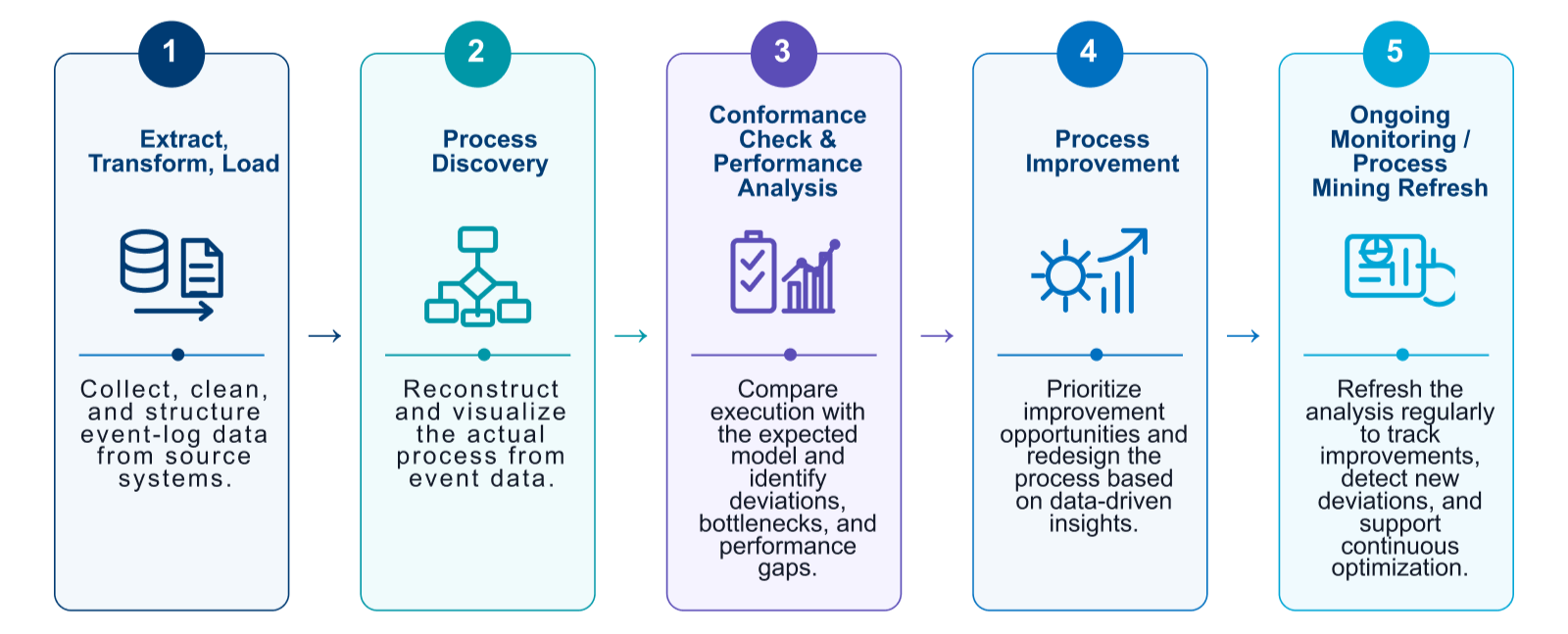
Process mining is the discipline that extracts real, data-driven insights from processes, directly from the event logs generated by IT systems every time someone creates a purchase order, approves an invoice, or makes a payment. While a process map shows the version of events that everyone agrees on, process mining shows what the systems actually recorded, and these rarely match. Therefore, the gap it seeks to bridge is the distance between how a process is designed on paper and how it is executed in practice. This is evidenced by fundamental techniques that work together, such as discovering the actual process from the data, verifying its conformity to the plan, and analyzing its performance over time.
A related technique, task mining, is also gaining traction alongside traditional process mining. While process mining focuses on end-to-end process flows captured in enterprise systems, task mining captures what happens at the desktop level, including clicks, keystrokes, screen views, and application steps that may not be fully logged in enterprise systems. Together, these techniques provide organizations with a more complete picture of how work is actually performed.
This distinction is important because most organizations, in a very real sense, operate based on assumptions. Processes are the backbone of how work gets done; however, most leaders have surprisingly limited visibility into how those processes actually behave once they move beyond the whiteboard and into the complexities of daily operations. Hidden inefficiencies, recurring bottlenecks, and silent compliance gaps accumulate costs and risks for years, often invisibly, because no one has the data to clearly identify them. Process mining replaces intuition and assumptions with evidence of what is actually happening, case by case, step by step.
That said, some organizations turn to process mining simply to improve operational efficiency, identifying bottlenecks that silently add days to a process. Others use it to anticipate compliance and audit requirements, since a clear record of how a process is executed in practice is far more robust than a theoretical description of how it should be. Many adopt it as part of a broader digital transformation or ERP optimization, where understanding the current process is the necessary first step before redesigning it. Increasingly, these same techniques are being applied to customer experience and service processes, analyzing customer experience with the same data-driven rigor as an administrative workflow.
Understanding where process mining ends and automation begins is also increasingly important. Robotic Process Automation, or RPA, uses software robots to mimic human actions in digital systems and automate repetitive, rule-based tasks. Process mining helps determine which tasks are worth automating by identifying the slowest, most error-prone, or most frequently omitted steps, so automation resources are directed where they can generate the greatest impact. The broader concept connecting the two is Intelligent Process Automation, or IPA, which combines process analytics, AI, and automation technologies to not only understand a process, but also actively improve its execution.
The Major Players in Process Mining Today
Process mining has evolved from a specialized analytical technique into a well-established market of tools and software, with several reputable enterprise vendors. Many of these platforms are recognized in Gartner's Market Guide for Process Mining, reflecting their enterprise-level adoption. Each takes a different approach, shaped by its origins and the technological ecosystem to which it belongs.
The Leading Vendors
Celonis is a cloud-based SaaS platform, primarily aimed at large enterprises, with deep integration with SAP and other major ERP systems. Its core engine builds process models using the PQL (Process Query Language), allowing teams to query event data the way they would query a database, and supports object-centric process mining, which models multiple interrelated objects (orders, deliveries, invoices) instead of forcing everything into a single case ID. Its premium pricing model is based on enterprise license subscriptions and features a robust AI layer, named the Execution Management System (EMS), which goes beyond dashboards to trigger real-time actions. It can flag a stuck invoice, recommend a specific intervention, and in some configurations push that action directly into a connected system. Celonis also offers a library of prebuilt connectors for major ERPs and a simulation engine to test process changes before deployment.
UiPath Process Mining is part of the UiPath Robotic Process Automation (RPA) ecosystem, making it ideal for organizations already using UiPath automation tools. Technically, it ingests event logs and automatically scores potential automation opportunities by estimated time savings and complexity, ranking them so teams know what to automate first. Its deployment is cloud-based through UiPath's Automation Cloud, with subscription pricing, and the platform prioritizes a comprehensive workflow from discovery to intelligent process automation and monitoring, including the ability to track the actual impact of a deployed automation against the original process baseline. It's an excellent choice for environments heavily reliant on RPA, though less flexible for organizations operating outside the UiPath ecosystem.
SAP Signavio Process Intelligence is integrated into SAP's Signavio process transformation suite. Beyond mining the as-is process from event data, it layers in collaborative BPMN-based process modeling, so business and IT teams can document target-state processes and measure live performance against them in the same environment. It includes SAP Business AI features for anomaly detection and benchmark comparisons, and value accelerators, pre-built content packages tailored to common SAP modules like Order-to-Cash or Procure-to-Pay, that shorten time to first insight. It is especially effective for SAP-led ERP transformation, process governance, process modeling, and continuous improvement programs. While it can also support non-SAP processes, it remains particularly relevant for organizations already using SAP.
IBM Process Mining is an AI-powered process intelligence platform designed to deliver end-to-end process visibility and transformation. Its prescriptive mining engine doesn't just surface bottlenecks; it ranks improvement opportunities by estimated financial or operational impact, and includes a built-in simulation capability to model the effect of a proposed change before committing resources to it. It also offers a conversational AI assistant that lets users ask questions about their process data in natural language rather than building dashboards manually. It appeals to companies seeking prescriptive insights, predictive and scenario-based analytics, and integration with IBM's AI process automation portfolio, which is especially useful for organizations that need to prioritize improvement opportunities based on their business impact and simulate changes before implementation.
Microsoft Power Automate Process Mining integrates this capability into the Microsoft Power Platform and Power Automate ecosystem. Technically, it connects directly to Power Automate flows, so an automation opportunity identified during mining can be handed off to a low-code flow without leaving the Microsoft environment, and process data can be pushed into Power BI for custom reporting alongside other business metrics. It's the ideal option for Microsoft-centric organizations that want to connect process analytics with low-code automation and reporting, enabling them to visualize real-world processes, compare behaviors, identify root causes, monitor KPIs, and uncover automation opportunities.
What do these tools have in common?
Despite their different ecosystems, these platforms share a common technical foundation and business model. In terms of capabilities, they all transform system data into process visibility, reconstructing the actual workflow across cases and activities, typically through process charts, dashboards, KPIs, variant analysis, bottleneck detection, and root cause investigation. They help organizations prioritize operational improvement, compliance correction, business process automation, and digital transformation initiatives, and are usually supported by enterprise-grade implementation, training, maintenance, and partner ecosystems, consistent with their positioning in the Gartner Market Guide for process mining.
Most of these companies follow a high-cost, subscription-based enterprise licensing model, run on a cloud infrastructure that pulls customer data from the organization's environment, and create vendor lock-in through deep integrations that make switching more expensive later. Implementation timelines are typically long, with equally long onboarding curves.
Introducing TDS Process Miner
TDS Process Miner, The dAIta Solution’s proprietary process mining tool is designed to deliver flexibility, speed, and data sovereignty, providing actionable process intelligence without the complexity and cost typical of traditional enterprise process automation vendors.
Key Features
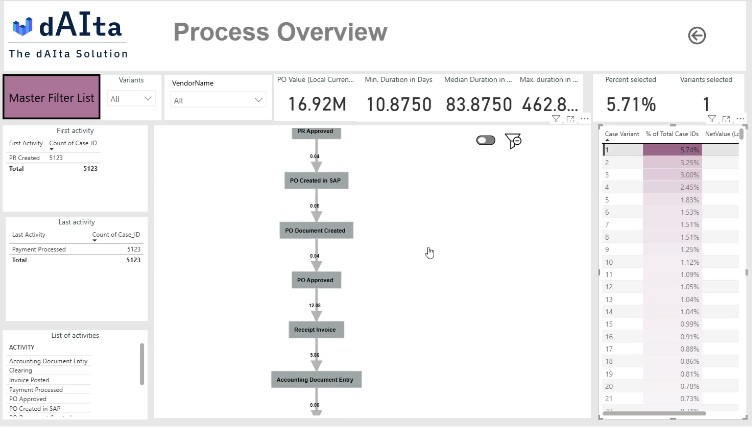
TDS Process Miner transforms event log data into a visual and quantifiable representation of actual process performance. By extracting key information such as case ID, activity, timestamp, resource, and other business attributes, the tool reconstructs process charts that show the actual sequence of activities, including variations, loops, delays, and exceptions.
The platform also enables KPI monitoring and bottleneck detection, helping teams track metrics such as processing time, wait time, approval delays, and exception rates. This information allows organizations to pinpoint where inefficiencies occur and which teams, vendors, regions, or process steps contribute most to performance issues.
Process Mining Vendor Feature Comparison
Legend: ✓ Strong/native capability | ◐ Available but ecosystem-dependent | ✕ Not a primary capability or positioning.
Furthermore, TDS Process Miner enables case variant analysis and root cause investigation. By grouping cases according to their actual activity sequence and combining them with business attributes, the tool helps distinguish the standard process path from rework loops, omitted steps, and recurring deviations. This provides organizations with a clearer basis for prioritizing process improvement actions.
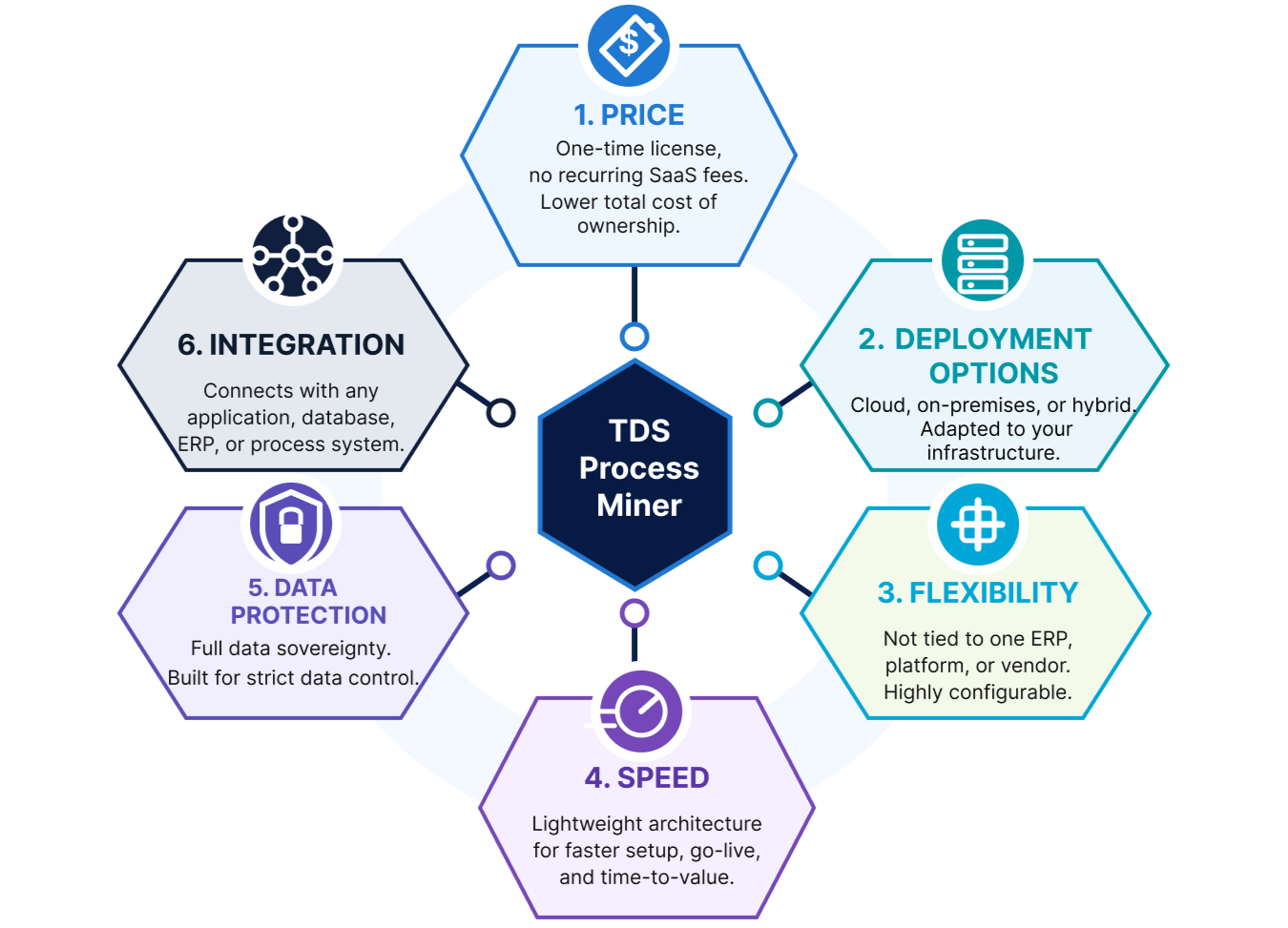
What sets TDS Process Miner apart is its delivery, deployment, and ownership model. From a cost perspective, instead of requiring customers to commit to a recurring SaaS subscription, TDS Process Miner is offered through a license-based model, allowing organizations to own their solution rather than rent it. This can result in a significantly lower total cost of ownership compared with traditional enterprise process mining platforms.
Deployment flexibility is another key differentiator. TDS Process Miner can support cloud, on-premises, or hybrid deployment models, allowing organizations to choose the architecture that best fits their infrastructure, security policies, and data governance requirements. This flexibility is particularly relevant for regulated sectors such as finance, healthcare, and government, where data residency, sovereignty, and internal control requirements are often critical.
The same architecture also supports faster implementation. Thanks to its lightweight and configurable design, TDS Process Miner can be deployed more agilely than many traditional enterprise solutions, reducing lengthy onboarding cycles and accelerating time-to-value. It also strengthens data protection by allowing customers to retain greater control over where and how their data is processed, while supporting compliance with GDPR and other data protection frameworks.
How the leading process mining solutions compare
The table below summarizes the key differences between TDS Process Miner and other leading enterprise vendors:
The dAIta Solution: Your Partner, Whatever Tool You Use
TDS Process Miner is an excellent tool for most use cases, but we also understand that every organization has specific needs, limitations, and technology preferences. No single tool is a perfect fit for every situation.
If you are still evaluating your options, we can guide you through an unbiased tool selection process built around your specific requirements. And if you have decided it is time to switch from one tool to another, we can manage that transition for you, end-to-end. Our consulting services cover the entire journey, from process discovery and tool selection, through implementation and integration, to ongoing monitoring and continuous process improvement.

See how your processes actually run before deciding how to improve them.
The dAIta Solution helps organizations uncover bottlenecks, variants, compliance gaps, and automation opportunities through practical process mining solutions.

About The dAIta Solution
The dAIta Solution provides strategic consultancy, process and data mining, analytics, reporting and automation implementation solutions powered by AI that enable organizations to achieve their full potential hidden within the information that they possess. Our proprietary mining and analytics techniques and vendor-agnostic AI and data software streamlines the path to results and facilitates automation of both the analysis of your organization and implementing solutions to weaknesses or growth opportunities identified. Founded by senior consultancy services executives, data scientists and former EY leaders, The dAIta Solution is headquartered in Los Angeles with operations in London, Lagos and Singapore. For more information, please visit thedaitasolution.com.
Latest Resources



Want to see The dAIta Solution in action?
Get in touch now for a free demo of the platform, our products and services