
AI Agents, AI Copilots, or Automation Workflows: Which One Does Your Business Actually Need?
Learn when to use AI copilots, automated workflows, and AI agents to solve the right business problem.

Every technology vendor is launching its own "agent" platform, executives are wondering if they really need one, and even long-existing automation products are suddenly being marketed as agents. Amid all this confusion, one fundamental question remains unanswered: what truly differentiates an AI copilot from, an automated workflow, and an AI agent? Understanding this is crucial when deciding what to develop in-house or acquire.
AI copilots typically have the least autonomy, as they provide support to a person rather than performing the work independently. Automated workflows can operate without continuous human intervention, executing predefined processes when an event is triggered. AI with agency goes further; instead of following a predetermined sequence, it can interpret a goal, determine the necessary steps, use tools, and adapt its actions within established limits.
However, this progression should not be interpreted as a simple classification from basic to advanced. Each model transfers a different type of responsibility from humans to the system. The right choice depends on what the process actually requires, not on the technology currently receiving the most attention. For organizations using AI in their businesses, the goal should be to adapt the operating model to the work, rather than adopting the latest buzzword.
What These Three Approaches Actually Mean
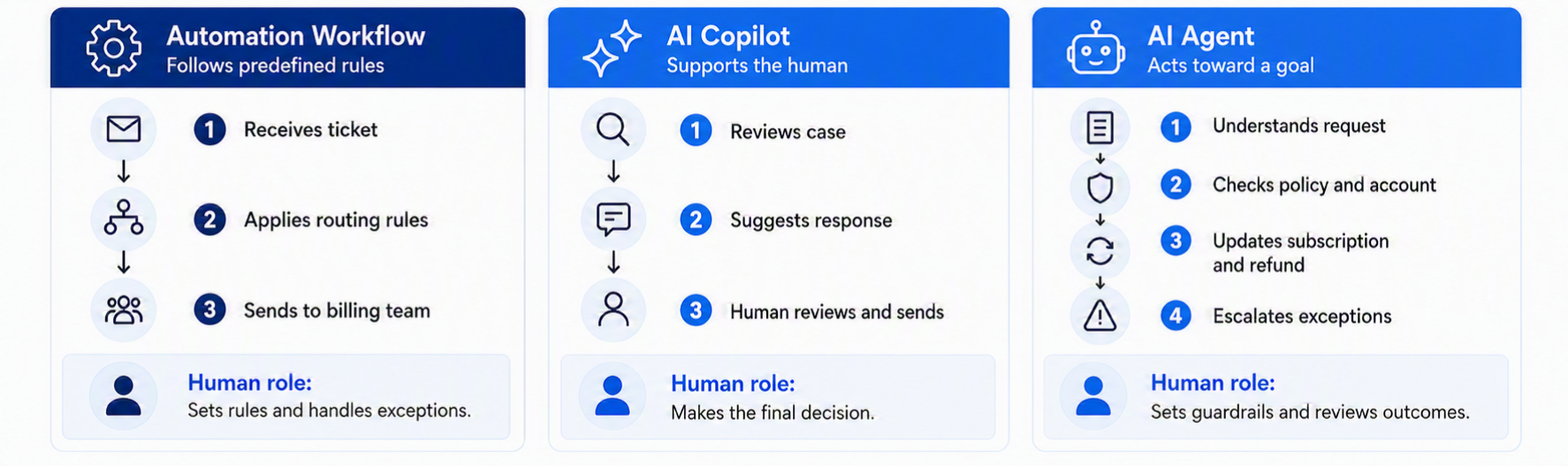
AI copilots, automated workflows, and AI agents are often grouped, but they are designed for different tasks. These approaches involve increasing levels of operational autonomy, but greater autonomy does not automatically make one option more valuable or appropriate than another. What matters is the type of work, where it's important to ask whether it truly requires human judgment, a fixed process, or some leeway for the system to resolve itself.
Copilots Help People Do Their Work
A copilot works alongside a person and helps them complete tasks more efficiently. It can search for information, summarise a file, draft a document, or suggest next steps. However, the user still initiates the interaction, reviews the output, and makes the final decision.
Consider a customer support ticket in which the customer writes: "I was charged twice after upgrading my subscription, and I'd like a refund." A customer service representative opens the Copilot and asks: "Can you summarise this ticket, review the refund policy, and suggest an appropriate response?"
The copilot reviews the customer's message, account history, and relevant policy, then drafts a recommended response. The representative reviews the output, adjusts it if necessary, and decides whether to send it or take further action.
The Copilot supports the employee, but it does not initiate or complete the process independently. The human user starts the interaction, interprets the recommendation, and remains responsible for the final decision.
This is why copilots are well suited to work that still requires human interpretation, judgement, or accountability, such as legal reviews, sensitive communications, and other nuanced tasks.
AI Automated Workflows Independently Execute a Predefined Process
A company chooses an automated workflow when it already knows how a process should run and wants it executed consistently and at scale, without requiring someone to approve each step. A defined event triggers the workflow, and the system executes the approved sequence independently.
Consider the same customer support ticket: “I was charged twice after upgrading my subscription, and I’d like a refund.”
With traditional automation, the workflow relies on structured input. For example, if the customer selects “Billing” on a support form, that selection triggers a predefined sequence: the system routes the request through the ERP, retrieves the customer’s account and invoice records, updates the CRM, sends an acknowledgement, and escalates the case if a defined condition is met.
With an AI-powered workflow, the customer does not need to select a category. An AI model reads the unstructured message, identifies it as a billing and refund request, assesses its urgency, extracts the relevant details, and passes that information into the same predefined workflow. From that point onward, the approved sequence remains unchanged.
A company would choose this approach because the process is predictable and the same approved sequence should occur for every similar request. Once the ticket is submitted, no customer service representative needs to review the request, decide what to do next, or trigger the process. The workflow executes the approved actions automatically until a predefined exception requires human intervention.
The difference between traditional and AI-powered automation is that traditional automation depends on structured inputs, while AI-powered automation can interpret unstructured requests before passing them into the same predefined workflow. The overall process, business rules, and exception paths remain exactly the same.
AI Agents Determine How to Pursue a Goal
Unlike an automated workflow, an AI agent is not limited to a predefined sequence of actions. Instead, it receives a goal and determines which approved steps, tools, and information are needed to achieve it.
Consider the same customer support ticket: “I was charged twice after upgrading my subscription, and I’d like a refund.”. Instead of triggering a fixed process, the system receives the goal: “Resolve this customer’s duplicate charge and refund request within company policy.”
The agent analyses the customer’s message, reviews the account and transaction history, retrieves the applicable refund policy, determines whether the request qualifies, updates the subscription, initiates the approved refund if permitted, communicates the outcome, and escalates the case to a human if it falls outside its authority.
The key difference is not the number of actions the agent performs. It is that the agent determines which approved actions are required based on the situation, rather than following one predefined execution path.
This makes AI agents the most autonomous of the three approaches. However, that autonomy must be controlled through permissions, approval thresholds, system access, monitoring, audit trails, and clear escalation rules. Allowing an agent to simply “figure it out” without those controls is very risky, not an advantage.
At a mature level, agentic AI does not replace automated workflows. Instead, it determines what needs to happen and then triggers predefined workflows to execute controlled, repeatable actions. The agent provides adaptive coordination, while the workflow provides reliable execution.
So, which one do you really need?
Don't think of them as rungs on a ladder. Think of them as three different tools for three different problems:
- Use a workflow when the process is predictable and repeatable.
- Use a Copilot when the task still requires human judgment.
- Use an agent when the system needs to make multiple decisions simultaneously, within the limits you control.
Often, just one of these options solves the problem. You don't need to use all three to appear sophisticated; you need to choose the right tool for each task.
Why "AI Agent" Has Become the Most Overused Term in Business Technology
The term “AI agent” is now used so broadly that it is becoming less useful for business decision-making.
Vendors increasingly describe chatbots, copilots, robotic process automation tools, and AI-enabled workflows as agents. But a system is not meaningfully agentic simply because it uses a large language model, generates a response, or performs an automated action.
Part of the confusion comes from the lack of a single, universally applied definition. Different providers use terms such as assistant, copilot, agent, and agentic automation in different ways, often to describe products with very different levels of independence.
This has created what Gartner refers to as “agent washing”, presenting a product as agentic even when it does not have substantial autonomous capability.
For businesses, this is more than a terminology problem. It can lead organisations to over-engineer simple workflows, underestimate governance and integration requirements, or compare tools that perform fundamentally different roles.
For this article, an AI agent is a system that receives a goal, determines the steps required, uses available tools, and executes multiple actions with controlled supervision inside defined guardrails.
This working definition helps distinguish genuine agentic behaviour from AI copilots, which operate under human direction, and AI automated workflows, which independently execute predefined processes.
What Changes as Autonomy Increases
Why AI Agents Are Not Automatically the Best Option

Dynamic reasoning only pays off when the job actually calls for it. If a process already runs on predictable inputs and clear rules, handing it to an agent that "figures things out on its own" usually doesn't buy you much; it just adds cost, more system access to secure, more testing, more monitoring, and more ways for things to go wrong.
Invoice routing, scheduled reporting, standard approvals, record synchronisation, and routine compliance checks are all highly structured and repeatable processes. An automated workflow is usually better suited to this type of work than an AI agent because the business needs the same approved steps to be executed consistently, with a clear audit trail of each action.
Copilots still make sense wherever judgment can't be outsourced. Legal analysis, executive communications, high-stakes client relationships, strategic calls. AI can genuinely help here, but the person stays the one making the decision.
Agents earn their keep when a process has to bend in real time across multiple systems and can't just be written out as a flowchart in advance. But "the system can decide for itself" should never mean "the system can do whatever it wants." What it can access, what it's allowed to spend, when it needs sign-off, when it has to stop and escalate, what it's never allowed to touch, all of that has to be spelled out, not assumed.
The more autonomy you give a system, the more responsibility falls on the people who deployed it, not just on the technology itself.
The Right Technology Is the One That Fits the Work
The question is not, “How do we implement AI agents?” It is, “What does this process actually need?”
If the work still depends on human judgement, a copilot may be the right choice. If the process is predictable and repeatable, an AI-automated workflow will usually deliver more value with less complexity. If the system must interpret changing situations, coordinate multiple tools, and determine the next steps toward a goal, an AI agent becomes the better fit.
AI copilots, automated workflows, and AI agents solve different operational problems. Copilots improve human productivity, automated workflows independently execute structured processes, and agentic AI interprets goals and dynamically coordinates actions.
As agentic systems mature, they will increasingly orchestrate automated workflows rather than replace them. The future is therefore unlikely to involve an organisation choosing one model for every process. It is more likely to be an operating environment in which copilots support judgement, workflows provide dependable execution, and agents coordinate work that requires adaptability.
The goal is not to make everything agentic. It is to apply the right type and amount of autonomy to each process.
The most valuable AI solution is not simply the one with the greatest autonomy. It is the one that transfers the right responsibility to the system while preserving the control, reliability, and accountability the business requires.

The Right AI Starts with the Right Process
Whether you need an AI copilot, an automated workflow, or agentic AI, we help you choose, design, and implement the solution that creates measurable business value.
About The dAIta Solution
The dAIta Solution provides strategic consultancy, process and data mining, analytics, reporting and automation implementation solutions powered by AI that enable organizations to achieve their full potential hidden within the information that they possess. Our proprietary mining and analytics techniques and vendor-agnostic AI and data software streamlines the path to results and facilitates automation of both the analysis of your organization and implementing solutions to weaknesses or growth opportunities identified. Founded by senior consultancy services executives, data scientists and former EY leaders, The dAIta Solution is headquartered in Los Angeles with operations in London, Lagos and Singapore. For more information, please visit thedaitasolution.com.
Latest Resources



Want to see The dAIta Solution in action?
Get in touch now for a free demo of the platform, our products and services