

FinOps emerged to address a problem that had become impossible to ignore: the cloud made technology spending far more variable, distributed, and hard to predict. Infrastructure could be spun up in minutes, consumption shifted constantly, and the people making technical decisions had growing power to directly influence costs.
That challenge has not disappeared. It has expanded. Similar economic models now exist across SaaS, software licensing, AI, data platforms, private cloud, and other parts of the technology estate. Technology leaders are therefore being asked to understand not only what the organization spends on cloud, but how a much broader portfolio of technology is consumed, who owns that consumption, and what business outcomes it supports.
The FinOps Foundation reports that 90% of respondents now manage SaaS or plan to within the next year., 64% manage licensing, 57% manage private cloud, 48% manage data centers, and 98% manage AI spend. The report describes FinOps as a multi-technology practice and frames the mission as moving from the cost of cloud toward the value of technology.
This article explores how FinOps is moving beyond cloud cost management, how it can work alongside Technology Business Management (TBM), and what technology leaders need to do to connect spend, consumption, ownership, and business outcomes. It also examines how stronger data foundations, accountability, and decision intelligence can support better technology investment decisions.
Key Concepts
TBM and FinOps: Two Complementary Views of Technology Value
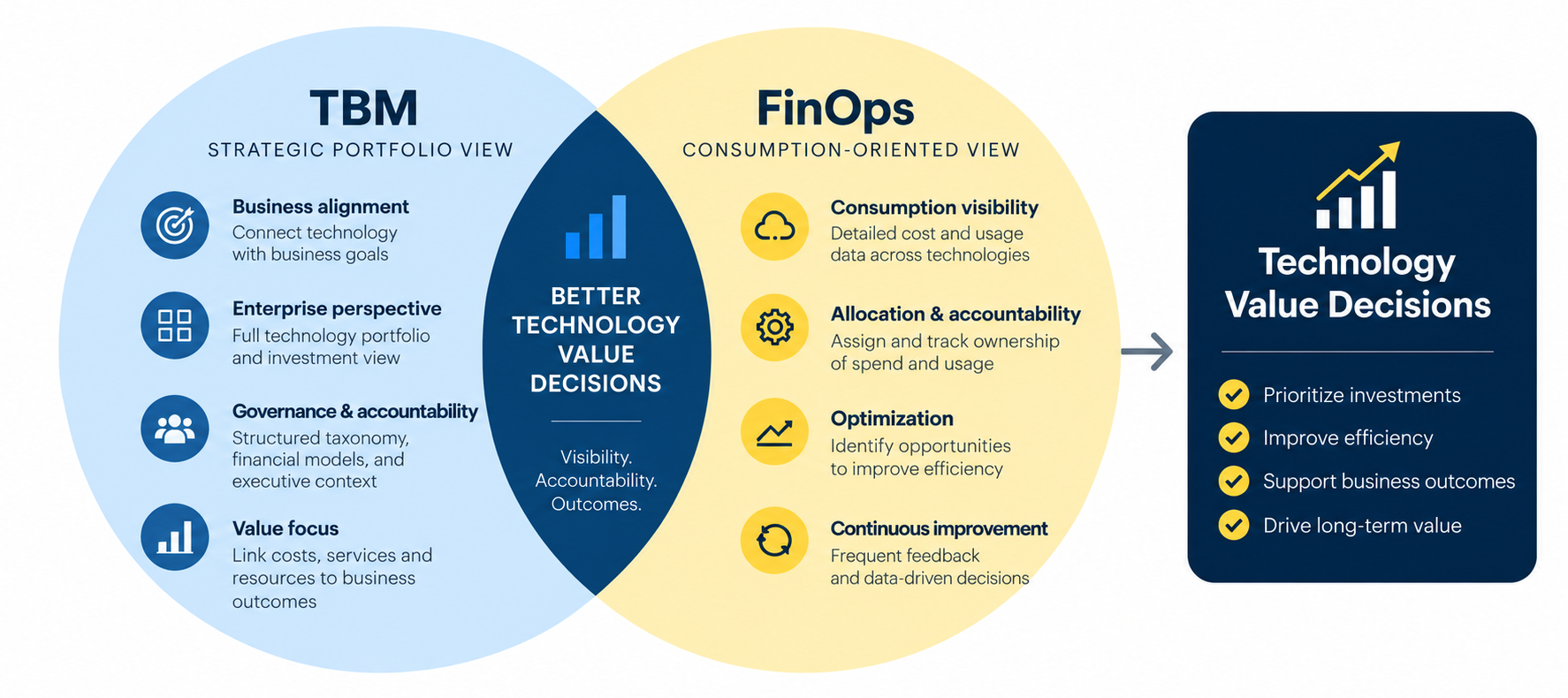
As FinOps expands beyond public cloud, it increasingly intersects with Technology Business Management (TBM). The TBM Council defines TBM as a strategic discipline for managing the value of technology across the enterprise by connecting resources and investments to business outcomes. In practical terms, TBM provides an enterprise-wide framework for understanding technology costs, how resources are allocated, which services and solutions they support, and how those investments align with business priorities.
FinOps approaches the problem from a different but increasingly complementary angle. It developed around the fast-moving economics of cloud and variable technology consumption, with strengths in granular cost and usage visibility, allocation, accountability, optimization, and frequent feedback. The 2026 FinOps Framework now applies those practices across categories including SaaS, AI, data cloud platforms, data centers, and public cloud, reflecting a much broader remit than traditional cloud cost management.
The two disciplines therefore tackle different parts of the same challenge. TBM contributes the portfolio structure, financial context, governance, and executive alignment needed to compare investments across the enterprise, while FinOps brings detailed consumption signals and faster operational feedback closer to the teams that can act on them. The TBM Council frames the two disciplines as explicitly complementary, with TBM providing the context, mapping costs to applications, services, and business value, while FinOps brings granular tracking of spend and usage, pushing accountability closer to the point of consumption.
More Technology Spend Does Not Mean More FinOps Value
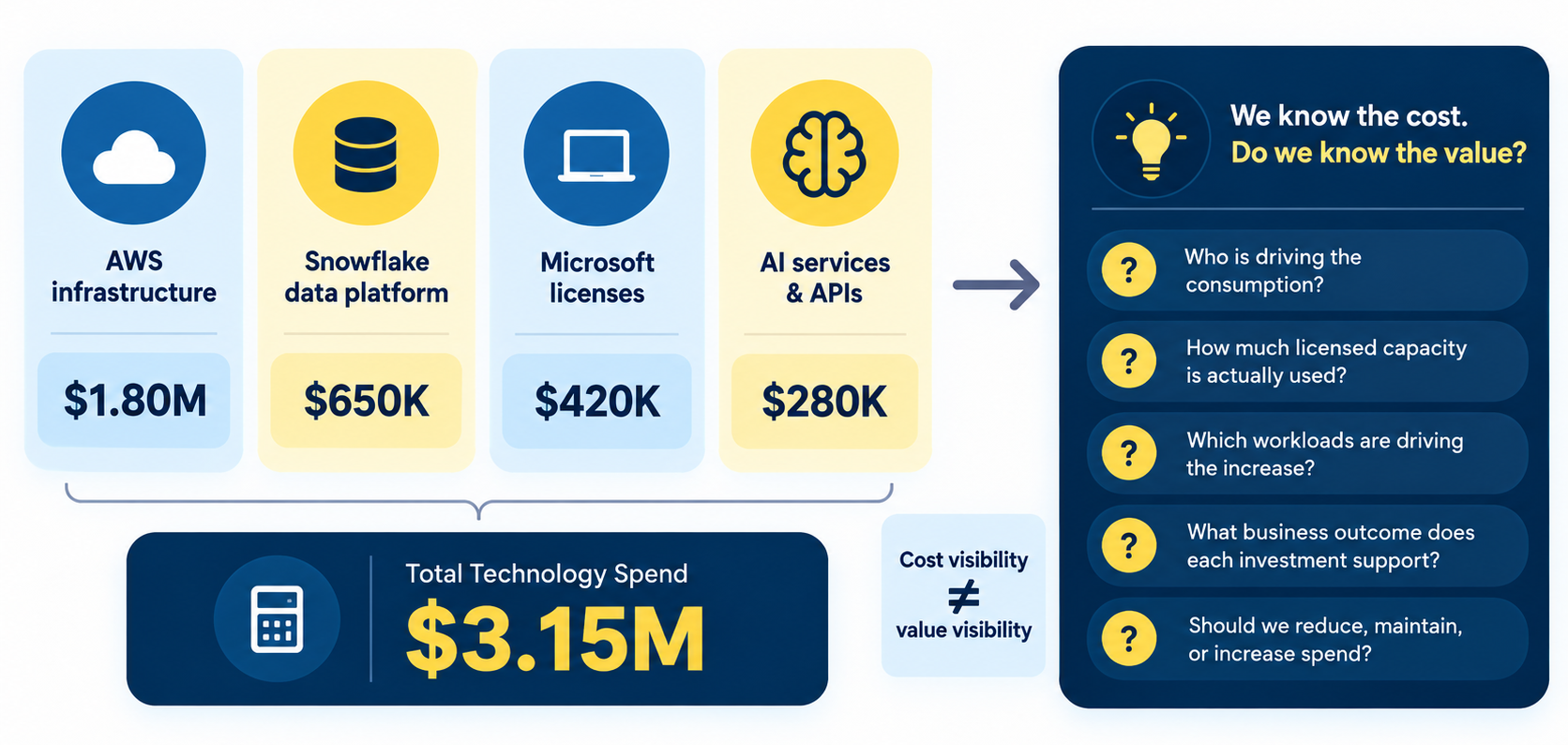
Expanding cost monitoring across more technologies does not automatically create a more mature FinOps capability. An organization can know exactly what it spends across AWS, a data analytics platform, Microsoft licensing, and AI services and still struggle to determine whether those investments are creating enough value.
Consider an illustrative mid-sized company that spends $1.80 million annually on AWS infrastructure, $650,000 on Snowflake, $420,000 on Microsoft licenses, and $280,000 on AI services and APIs. The total technology spend across those four categories is $3.15 million. The company may be able to explain every invoice and month-over-month change, but that visibility alone does not show which teams are driving consumption, how much licensed capacity is actually used, which workloads are responsible for growth, or what business outcome each investment supports.
The Real Shift: From Cost Optimization to Value Accountability
Traditional FinOps questions remain essential: Where are we overspending? Which resources are underutilized? Can commitments or pricing be improved? Are teams staying within budget? These questions protect efficiency, but they describe only one dimension of technology economics.
Technology leaders increasingly need to ask a second set of questions. What business capability does this spending support? Who owns the consumption? Is utilization consistent with what the organization is paying for? What is the cost per meaningful unit of activity? What happens if the organization increases or reduces the investment? And which technology investments should be prioritized when capital and operating budgets are constrained?
That distinction matters because the best FinOps decision isn't always to cut spend. If additional investment in a data platform boosts processing capacity, shortens reporting cycles, improves customer responsiveness, or enables faster decisions, a higher bill may actually reflect better economics. Performance analytics therefore becomes just as important as cost analysis, leaders need to understand not just how spending changes, but what operational performance shifts along with it.
The Missing Connection: Spend, Consumption, Ownership, and Outcomes
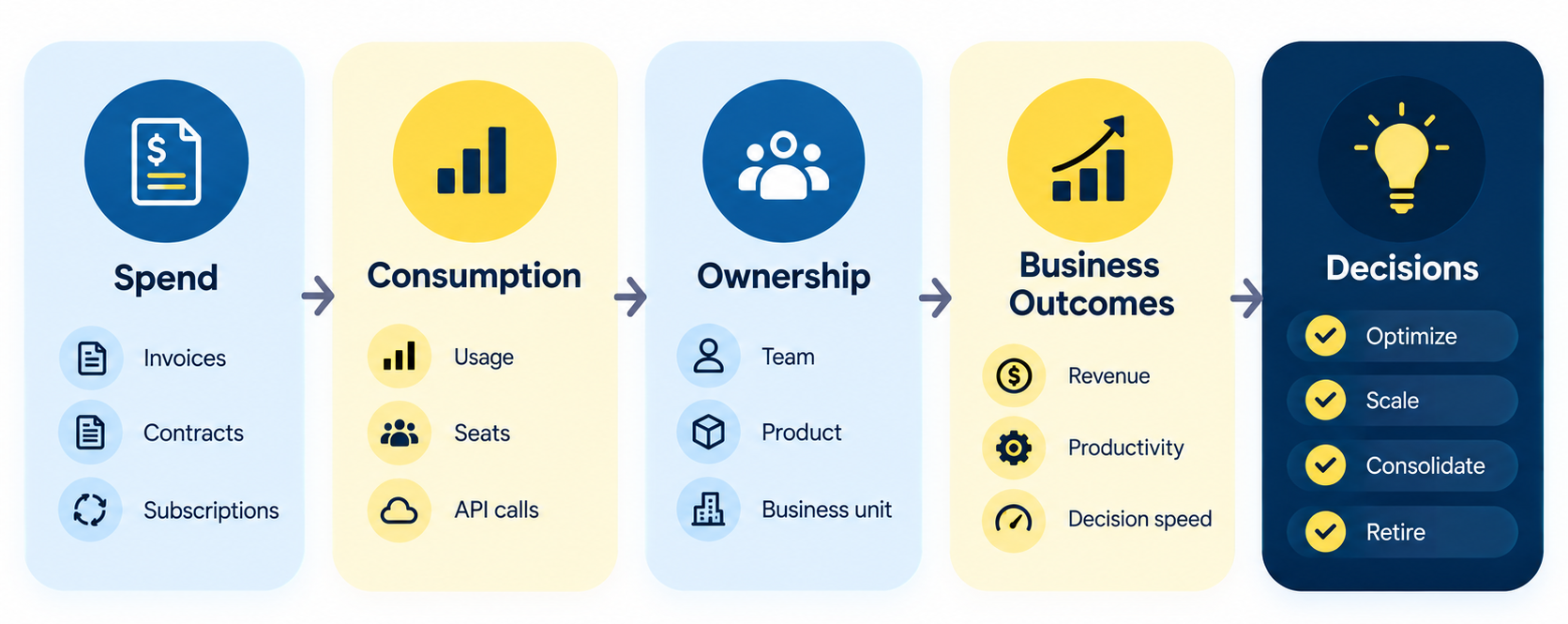
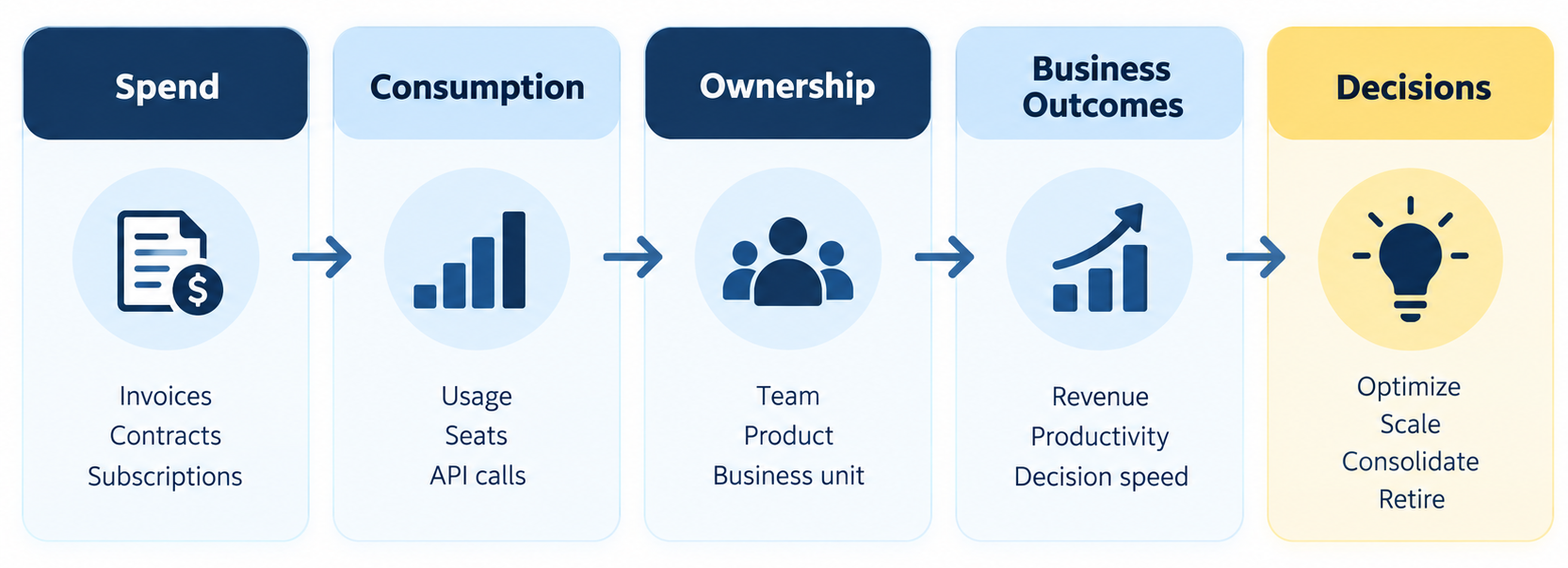
Technology value cannot be understood from billing data alone. Organizations need to connect four dimensions that are often stored in different systems. Spend explains what was paid through invoices, subscriptions, contracts, commitments, and licenses. Consumption explains what was actually used through compute, storage, seats, API calls, queries, credits, or AI tokens. Ownership identifies the team, product, application, project, business unit, or customer responsible for that use. Business outcomes describe what the consumption produced, such as transactions processed, customers served, revenue supported, reports delivered, productivity gained, or time saved.
The final step is the decision. Should the organization maintain the investment, scale it, optimize it, consolidate it, renegotiate the commercial model, migrate the workload, replace the solution, or retire it? This is where decision intelligence becomes practical. It is not another dashboard category; it is the ability to combine financial, operational, and business context so a technology decision can be made with less uncertainty.
A monthly data platform bill, for example, may show that expenditure increased 18%. Usage telemetry may show that analytics workloads increased 30%. Business data may then show that the platform is supporting a fast-growing product while cost per transaction is declining. Those statements describe the same expenditure, but they lead to very different decisions. The quality of the decision depends on the quality of the connections between the data.
Technology Leaders Need a Decision Model, Not Another Cost Dashboard
A modern FinOps capability should ultimately answer four questions in sequence. First, what are we spending? Organizations need enough visibility across the technology portfolio to understand material expenditure, without assuming every source must be centralized immediately. A practical starting point is where spend is high, growth is high, and visibility is low.
Second, who or what is consuming it? Connecting spend to accountable teams, products, applications, business units, projects, or customers moves the organization from allocation toward accountability. Third, what outcome does that consumption support? This is where unit economics becomes useful. Cost per transaction, cost per active customer, cost per analytics workload, cost per AI interaction, or cost to support a product can reveal whether consumption is becoming more or less efficient as demand changes.
Fourth, what decision should we make? The analysis should lead to a repeatable choice: keep, scale, optimize, consolidate, renegotiate, migrate, replace, or retire. A mature FinOps practice shouldn't stop at a dashboard; it should reduce uncertainty around a technology investment decision and give leaders enough context to act.
FinOps Needs to Move Earlier Into the Technology Decision Cycle
One limitation of traditional cost management is timing. Financial analysis frequently happens after a platform has been selected, a contract signed, an architecture designed, or a workload deployed. By then, some of the most important economic decisions have already been made. A more strategic model brings financial and consumption intelligence into planning, architecture, vendor selection, procurement, deployment, optimization, and renewal.
The shift is already visible organizationally. The FinOps Foundation reports that 78% of FinOps practices now report into CTO or CIO organizations. Practices with VP-level or higher executive engagement show roughly two to four times more influence over certain technology-selection decisions, including cloud service selection, provider selection, and cloud-versus-data-center placement. The 2026 FinOps Framework also introduced Executive Strategy Alignment, formalizing the connection between FinOps data, strategic priorities, and executive decision-making.
FinOps creates more value when it helps shape a technology decision before spend is committed, rather than simply explaining the cost after the fact. This is also where TBM and FinOps reinforce one another, with TBM providing the strategic portfolio context while FinOps delivers more frequent cost and consumption signals closer to operational decisions.
The Data Foundation Becomes Critical
Broader FinOps also raises a data challenge. The information needed to evaluate technology value rarely lives in one system. Billing platforms know what was charged. Usage telemetry knows what was consumed. Procurement and contract systems know commercial terms. Organizational data identifies owners. Application and operational systems know which workloads were involved. Business systems know whether the activity generated revenue, improved service, reduced processing time, or supported another measurable outcome.
The problem is therefore often not a lack of data, but a lack of connected, trusted, and consistently defined data. Effective data governance becomes essential because allocation rules, ownership definitions, cost categories, and business metrics need to mean the same thing across Finance, Technology, Procurement, and Business teams. Without that consistency, organizations can create sophisticated reporting while still arguing about which number is correct.
The architecture matters as well. A well-designed data platform or data analytics platform can integrate billing, usage, contract, organizational, operational, and business-performance data into a common analytical layer. But the technology alone does not create value. The data model, governance rules, ownership structure, and decision process determine whether the platform supports genuine data driven decision making or simply produces more reports.
This is also why the FinOps Framework emphasizes timely, accurate, and accessible data and why its technology-category model recognizes that SaaS, AI, data cloud platforms, data centers, and public cloud have different procurement models and usage signals. A common analytical foundation must preserve those differences while still allowing leaders to compare investment choices.
What Technology Leaders Should Do Now
Organizations do not need to solve the entire technology estate at once. A pragmatic approach starts by mapping the largest technology-spend categories and identifying where financial and consumption data currently resides. Material areas where spend is increasing quickly, accountability is unclear, or visibility is weak should receive priority.
The next step is to connect those costs progressively to usage, owners, products, services, and relevant business outcomes. Measurement should then move beyond aggregate spend toward utilization, adoption, forecast variance, unit economics, total cost of ownership, and performance analytics where those measures improve a real decision. Finally, leaders need a repeatable mechanism for deciding when technology should be scaled, optimized, consolidated, renegotiated, replaced, or retired.
The goal is not an enterprise-wide model with perfect attribution on day one. It is a decision system that becomes more reliable over time as data quality, ownership, and measurement mature.
How The dAIta Solution Helps Connect FinOps and TBM to Drive Technology Value
The dAIta Solution helps organizations move from fragmented technology spend data toward a clearer view of how cost, consumption, ownership, and business outcomes connect. The approach starts by establishing a reliable baseline of technology economics, then linking financial, operational, and consumption data so leaders can understand not only what they are spending, but what that spending supports.
From there, organizations can develop more meaningful technology value metrics, identify where optimization or additional investment can create the greatest impact, and prioritize actions based on financial value, business relevance, technology criticality, and implementation effort. The goal is to create a practical roadmap for better technology investment decisions, not simply lower costs.
The Right FinOps Question Is Not “What Did We Spend?” It Is “What Value Did It Create?”
FinOps is expanding beyond cloud because the economics of technology have changed. SaaS, licensing, AI, private infrastructure, and data platforms increasingly combine recurring commitments, variable consumption, decentralized ownership, and complex pricing. Simply adding those categories to a cost dashboard will not solve the larger management problem.
Cost visibility remains necessary, but it is no longer sufficient. Technology leaders need to understand what consumption is supporting, who can influence it, what unit economics reveal about efficiency, and which business outcomes justify continued investment. That requires stronger data governance, a connected data analytics platform, meaningful performance analytics, and a culture of data driven decision making.
The organizations that get the most from FinOps will not necessarily be those that reduce technology spending the most. They will be those that can identify where technology creates value, where it does not, and redirect investment accordingly. TBM provides an enterprise framework for that conversation; FinOps brings more granular cost and consumption accountability. Together, supported by reliable data and decision intelligence, they can move technology management from reporting what was spent to deciding what should happen next.

Turn Technology Spend Into Better Decisions
Connect cost, consumption, ownership, and business outcomes with The dAIta Solution.

About The dAIta Solution
The dAIta Solution provides strategic consultancy, process and data mining, analytics, reporting and automation implementation solutions powered by AI that enable organizations to achieve their full potential hidden within the information that they possess. Our proprietary mining and analytics techniques and vendor-agnostic AI and data software streamlines the path to results and facilitates automation of both the analysis of your organization and implementing solutions to weaknesses or growth opportunities identified. Founded by senior consultancy services executives, data scientists and former EY leaders, The dAIta Solution is headquartered in Los Angeles with operations in London, Lagos and Singapore. For more information, please visit thedaitasolution.com.
Latest Resources



Want to see The dAIta Solution in action?
Get in touch now for a free demo of the platform, our products and services