

The Difference Between IT, Analytics, and AI Leadership
Most organizations have been investing in technology for years; as a result, they have built data platforms, implemented analytics practices, and are now making a strong commitment to AI. However, they have not invested much in clarifying who is responsible for what, as these capabilities increasingly overlap.
IT leaders are under increasing pressure. Data analytics and AI are no longer isolated initiatives; they are integrated into operations, run parallel to core business processes, and influence how work is done. Yet expectations have expanded without organizational structures, roles, or accountability frameworks, adapting accordingly.
The result is a latent tension that most leadership teams sense but have not formally addressed: the boundaries of leadership between IT, data analytics, and AI have never been clearly defined. And when AI makes or influences decisions on a scale, who is accountable for the outcome? In most organizations, these boundaries are assumed rather than designed. This matters because AI is introducing a category of questions for which traditional IT governance was never designed.
Summary of key concepts
What are IT, Analytics, AI and Leadership?
One of the most persistent sources of confusion in modern business is that IT, Analytics, and AI are often discussed as if they are interchangeable. In practice, however, they operate at fundamentally different layers, solve distinct problems, and produce different types of value.
IT
The IT department serves as the technical foundation of the organization, encompassing the “where” and “how” of technology, including systems, infrastructure, cloud environments, and the integration layers that manage data. The IT department’s primary mission is to ensure availability, reliability, and security across the entire environment. Essentially, IT creates vital conditions that enable higher layers to exist. Without a stable foundation, data analytics and AI simply cannot function reliably.
Analytics
Analysis provides interpretation. This area is responsible for converting raw data into business logic, metrics, and meaningful performance measurements. Its role is to translate what happens at the technical layer into the organizational context. The true outcome of analytics is insight, which provides visibility into trends, identifies patterns, and highlights where risks or opportunities may lie. However, it is important to remember that information alone does not guarantee action.
AI
AI marks the shift from interpretation to execution. Its scope encompasses models, predictive logic, and intelligent workflows designed to translate insights into immediate action. Whether generating recommendations, automating processes, or prioritizing tasks, AI directly influences operational behavior on a large scale. AI is more than a technical capability; it is an operational commitment that requires oversight to ensure it aligns with the organization’s goals and ethics.
Leadership
Leadership while distinct for each of these three areas, also serves as the connective tissue that binds them together. Its scope is not technical, but strategic: defining direction, assigning ownership, and ensuring execution.
The output of effective leadership is coordinated decision-making and measurable business results. To operate effectively, leaders must focus on cross-functional alignment, strategic accountability, and change management. Ultimately, leadership determines how these layers interact. Without clear structures of ownership, an organization can invest heavily in technology while still struggling to make consistent, effective decisions.
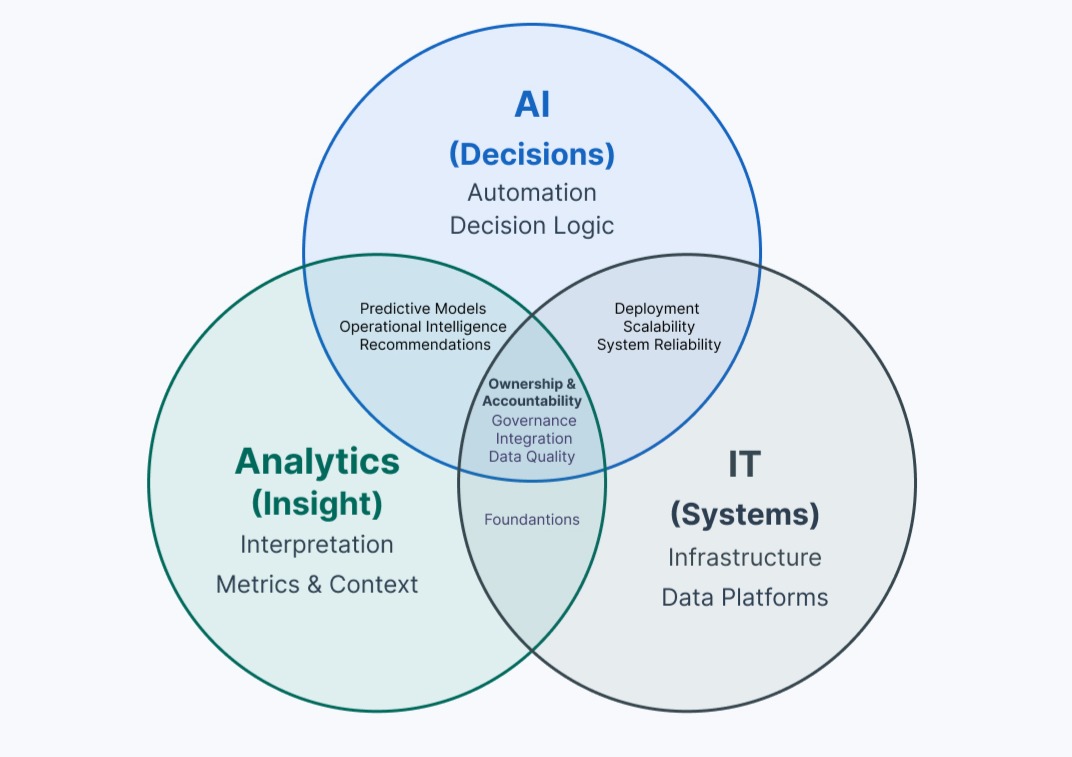
The three domains of leadership
Organizations need definitions that reflect what each function is responsible for when it is operating well. Three distinct leadership domains shape how organizations move from data to decision.
IT leadership
IT leadership owns the infrastructure that makes data and technology usable at scale. This means systems, platforms, integration layers, security, and the reliability of the environment in which everything else runs. An important part of that responsibility is system integrity, maintaining the security, availability, and consistency of the technical environment that supports data and AI use. When system integrity holds, data is accessible, pipelines are stable, and the organization can trust that what it sees reflects what is happening.
Although it is an important responsibility, it does not involve answering business questions. Information technology creates the conditions necessary for gaining insights and making decisions. However, it does not provide direct answers
Analytics leadership
Analytics leadership is responsible for interpretation; it takes the data provided by the IT department and transforms it into structured insights: metrics, trends, and performance descriptions. It defines what is measured, why it matters, and how to interpret it.
The limitation of analysis alone is that it still requires human judgment to take action. Information alone does not guarantee action, and visibility does not guarantee the right decision. Analysis frames what is happening and, sometimes, why, but it does not generate the result.
AI leadership
AI leadership oversees the decision-making logic and is responsible for the models and automation that translate insights into actions: recommendations, predictions, and, in some cases, decisions executed without human review.
When decisions are embedded in models and automation, the question of who is responsible for the outcome cannot be answered by pointing to the tool. It requires deliberate governance; someone must define what the model is being optimized for, how its results will be validated, and who is accountable when something goes wrong.
Why does this matter now?
There are three key important reasons why does this matter
1. Data saturation without decision clarity
Many organizations have reached a point where more data and reports do not proportionally provide greater clarity, leading to information overload. Leaders have access to more information than ever before, but that does not always enable them to make better decisions. The bottleneck has shifted from data availability to the quality of decisions, and that is a problem of governance and accountability, not a technological problem.
2. Increasing operational complexity
The second is operational complexity. AI is no longer a research function; it is being used in supply chains, pricing systems, customer interactions, and financial models. When intelligence is integrated into operations at this scale, the question of who owns the output of that intelligence is no longer merely theoretical. It has direct consequences for risk, regulatory compliance, and trust in the organization.
3. Blurring leadership boundaries
The third is the blurring of leadership boundaries. As IT, analytics, and AI capabilities converge within the same platforms and workflows, the lines separating who is responsible for what becomes harder to draw.
Organizations that do not address these dynamics will find themselves in a familiar but increasingly dangerous position: capable systems producing outputs that no one is fully accountable for.
From technical ownership to decision and governance ownership

The most important change for business leadership right now is not about adopting a new tool or reorganizing a hierarchical structure; it is about changing the way leadership itself is defined, and that starts with understanding the difference between three distinct types of responsibility.
Most IT organizations have experience and expertise in this area. They know how to measure uptime, manage vendor relationships, and maintain data quality. These are real and important capabilities, and they remain the foundation upon which everything else is built.
Decision-making accountability requires that a person, a team, or an executive be accountable for a decision and its outcome. This includes defining what information the decision is based on, who has the authority to make it, and how performance will be tracked and evaluated over time.
Governance accountability is the layer that holds everything together; it ensures that accountability structures are in place, that decisions are made in alignment with the organization’s values and risk tolerance, and that the decision-making system itself can be audited and improved over time. As AI implements more decisions, the responsibility for governance shifts from a compliance function to a strategic one.
As AI becomes more operationally significant, leadership teams that think in terms of technical ownership alone are going to find themselves exposed. The question is no longer only whether the system is working. It is whether the decisions the system is making are the right ones, who is responsible for defining what "right" means, and what happens when they are not.
A Decision System in Practice

How a trusted technology partner augments your organizational leadership
As organizations scale analytics and AI initiatives, the challenge is no longer only technological capability. It is leadership alignment across infrastructure, insight, decision-making, and governance.
A trusted technology partner helps organizations align these functions into a coordinated operational framework:
- IT supports reliable and governed infrastructure
- Analytics creates consistent business understanding
- AI operationalizes decisions responsibly
- Leadership defines accountability and oversight
At The dAIta Solution, we help enterprises strengthen the connection between IT, analytics, and AI so organizations can move from isolated technical capabilities toward coordinated, accountable, and scalable decision systems.
The new leadership stack
.png)
These are not competing functions, but rather a sequence in which each level depends on the others to generate value. The IT director who dismisses analytics as a business issue, or the analytics lead who views AI as the IT department’s responsibility, is failing to harness the organization’s full potential.
What is changing is not the role of technology in the enterprise, but what is expected of leadership. The bar has shifted from implementing capable systems to being accountable for the results those systems produce.

As organizations move from data to automated decisions, who truly owns the outcome?
Explore our offerings and acquire an expert partner today.

About The dAIta Solution
The dAIta Solution provides strategic consultancy, process and data mining, analytics, reporting and automation implementation solutions powered by AI that enable organizations to achieve their full potential hidden within the information that they possess. Our proprietary mining and analytics techniques and vendor-agnostic AI and data software streamlines the path to results and facilitates automation of both the analysis of your organization and implementing solutions to weaknesses or growth opportunities identified. Founded by senior consultancy services executives, data scientists and former EY leaders, The dAIta Solution is headquartered in Los Angeles with operations in London, Lagos and Singapore. For more information, please visit thedaitasolution.com.
Latest Resources



Want to see The dAIta Solution in action?
Get in touch now for a free demo of the platform, our products and services