

Will Execution Finally Beat the Hype?
For much of the last decade, data and AI strategy has been dominated by possibility rather than performance. Ambition consistently outpaced execution. In 2026, that imbalance stops being tolerable.
Across vendors, analysts, and practitioners, one message is becoming unavoidable: AI is no longer experimental, and data is no longer optional. The organizations that win in 2026 won’t be the ones with the most advanced models they’ll be the ones with the discipline to operationalize AI responsibly, measurably, and at scale.
Below we outline top trends that we see in the market and our bold predictions for 2026 arising from this.
1. Data readiness becomes the real competitive advantage
Cisco’s AI Readiness Index found that only 34% of organizations surveyed rated their data preparedness as such, and only 32% of organizations rate their IT infrastructure as being fully AI ready. The myth that “better models fix bad data” is well and truly debunked. Performance is constrained by data quality, lineage, semantics, and accessibility. Those who invested early will compound value; and those who didn’t will hit a ceiling.
2. Unstructured data enters the core data stack
Text, documents, audio, and video stop being “outside the pipeline.” Unstructured data becomes first-class input for enterprise AI - forcing architectural and governance changes.
3. Agentic AI Redefines How Work Gets Done
a) Agentic AI becomes the default enterprise architecture
Agentic AI moves from demos into core systems. Instead of isolated copilots, organizations deploy goal-driven agents that plan, reason, and act across systems. In these systems, distinct agents assume roles such as “Planner,” “Coder,” “Risk Officer,” or “Auditor,” collaborating to execute complex workflows.
b) AI ecosystems replace one-off AI projects
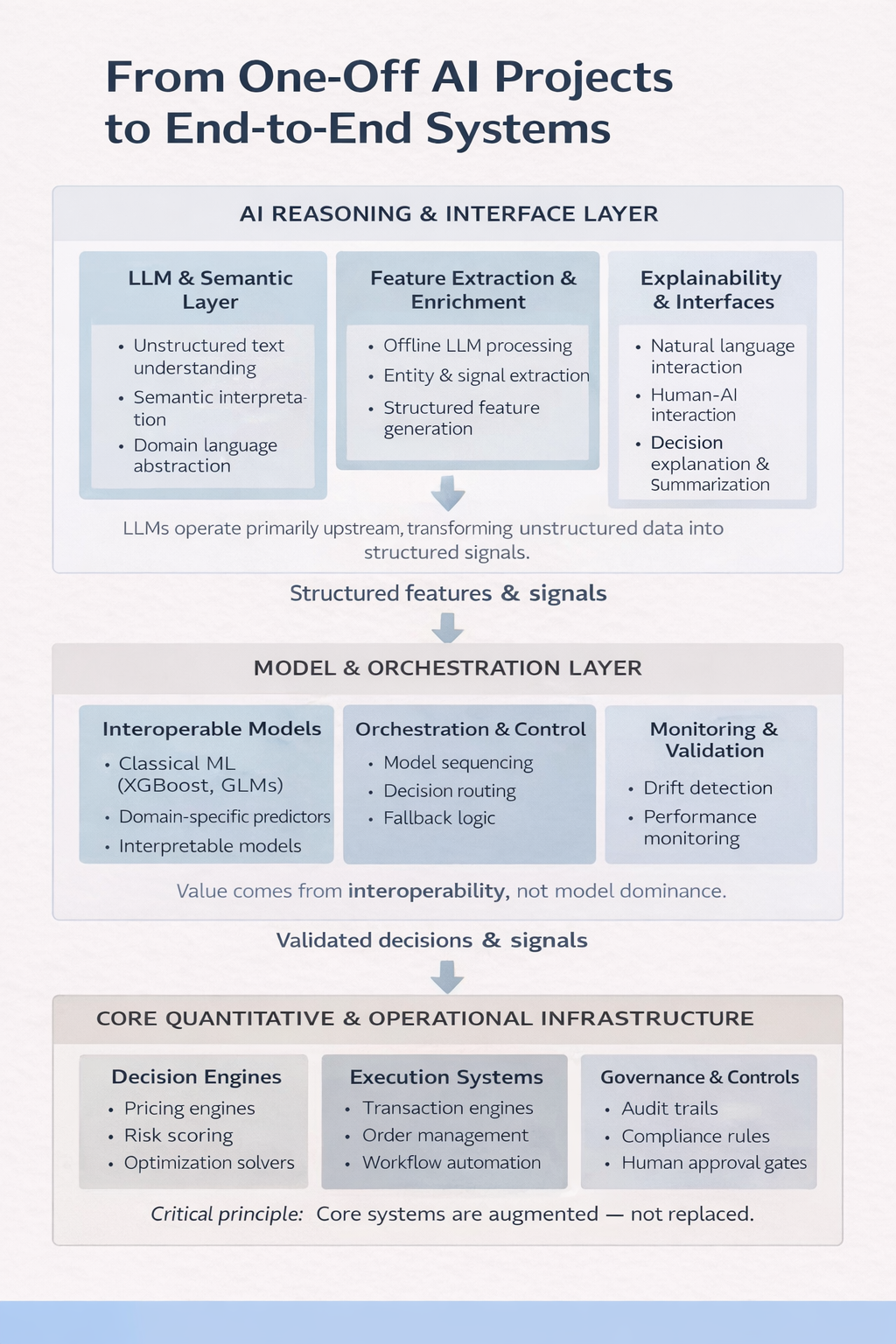
Standalone use cases increasingly fail. Value shifts to end-to-end ecosystems: shared data foundations, interoperable models, orchestration layers, and governance by design. Rather than displacing incumbent quantitative infrastructure, modern AI is increasingly integrated as a reasoning and interface layer on top of established engines. In these hybrid technology stacks, LLMs are often utilized “offline” to extract features from unstructured text, which are then fed into robust, lightweight classical models (such as XGBoost) for final prediction.
c) Observability becomes the price of entry for agentic systems
If you can’t explain what an agent did, why it did it, and with which data, you won’t deploy it on a scale. Observability - monitoring decisions, reasoning paths, and outcomes - becomes mandatory (especially in regulated environments).
d) Enterprises choose simplicity over theoretical performance
A backlash against over-engineered AI stacks grows. Many organizations favor simpler, more interpretable architectures that are easier to govern and maintain even at the expense of marginal gains. To mitigate the bias and error risks, organizations are adopting "White Box" architectures that position LLMs as critics and auditors. A simpler model is at the core while the AI agents are used to ground/validate the outputs.
e) A standard AI protocol layer emerges
Agent-to-agent communication and orchestration increasingly rely on standardized protocols. This layer becomes as important as APIs were, reducing integration friction and vendor dependency.
f) Context engineering becomes a strategic capability
The limiting factor for agents won’t be intelligence, it will be context. Organizations that can manage memory, semantics, and situational awareness will outperform those that simply swap models.
g) Relational databases power agent memory and state
Despite vector database hype, relational systems (often Postgres) remain foundational for managing state, transactions, and long-term agent memory.
h) Conversational interfaces replace dashboards
Static dashboards and spreadsheets are increasingly complemented or replaced by conversational interfaces that let users ask questions, explore scenarios, and act directly.
i) Humans stay in the loop by design
Full automation remains rare. The highest-performing systems embed human oversight intentionally, especially for high-impact decisions.
j) AI agents enter core commercial operations
From pricing to negotiation to payments, agents move into commercial workflows reshaping how B2B transactions happen. Google just published the first draft of Universal Commerce Protocol (UCP), an open standard to help AI agents order and pay for goods and services online. And its rival OpenAI launched a new feature last October that allowed users to discover and use third-party applications directly within the chat interface, at the same time publishing an early draft of a specification co-developed with Stripe, Agentic Commerce Protocol, to help AI agents make online transactions.
4. Security, Trust and Governance Determine Whether Solutions Can Scale
a) AI governance becomes operational, not aspirational
Cisco’s AI Readiness Index 2025 found that just 23% of organizations considered their governance processes primed for AI. In 2026, governance moves out of policy decks and into pipelines, workflows, and system controls. Governance mechanisms including logging, rule-based overlays, and unlearning protocols are being treated as primary design requirements rather than afterthoughts.

b) Cybersecurity becomes an AI arms race
AI accelerates both cyber defense and cybercrime. Organizations that treat AI security as “traditional security plus a chatbot” will fall behind those adopting AI-native security strategies.
c) Sophisticated data protection methods will be deployed
With strict regulatory constraints on data sharing, the focus is turning toward adapting LLMs for tasks without exposing sensitive information to third-parties using techniques such as context-masked meta-prompting - which sanitizes inputs prior to inference - and the generation of offline, reusable prompt templates are becoming standard. Similarly, synthetic data is evolving into a core infrastructure tool. Multimodal datasets are now being created that preserve the statistical properties of sensitive data without exposing the underlying records. Such manufactured data are incredibly useful for simulations, stress testing, model training and validation.
d) AI failures escalate to the C-suite
When AI fails publicly or financially, accountability lands on executive leadership. Governance gaps stop being defensible.
e) Ungoverned AI becomes a material business risk
Organizations that deploy AI without governance, literacy, and controls will incur real financial, legal, and reputational losses. In 2026, this becomes measurable not hypothetical. Regulatory frameworks like the EU AI Act are driving a transition from periodic model validation to compliance as a continuous architectural process. Systems will be required to generate automated evidence of adherence, managing model drift and fairness violations dynamically as they emerge.
“43% of organizations have a formal AI governance policy in place”
PEX Report 2025/26
5. An Increased Imperative for Value from Data and AI Initiatives
“56% of companies report no measurable value from AI investments”
PwC – World Economic Forum, Davos 2026
Most research to date have found AI initiatives to have fallen short of expectations. MIT’s "The GenAI Divide: State of AI in Business 2025", found a staggering 95% failure rate for enterprise generative AI projects, defined as not having shown measurable financial returns within 6 months. In 2026, we expect to start to see significant returns on enterprise AI investments due to:
a) Organizations are adopting a more strategic approach
Productivity, not experimentation, will drive AI spend. Two years ago, there was a lot of experimentation and proofs of concept; now the focus has shifted to transformation, with the most sophisticated management teams looking for returns within 12 months. AI had been deployed to solve pain points but now it is increasingly used to rethink how things are done from the ground up.
b) CFOs force a reckoning on AI investments
Finance leaders move to the center of AI decision-making. Budgets come under scrutiny, and projects without a credible path to value are delayed, downsized, or shut down. This financial pressure acts as a forcing function aligning AI initiatives with enterprise priorities instead of isolated team ambitions.
c) Legacy technology debt stops being the main bottleneck
In the early GenAI wave, outdated infrastructure and fragmented data blocked progress. By 2026, many future-focused organizations have paid down enough legacy debt to allow AI systems to scale. The constraint shifts from infrastructure readiness to execution discipline.
d) Open-source options and neocloud providers reshape the AI cost curve
To control spend and reduce dependency, organizations adopt open-source models and specialized AI infrastructure providers. Open-source models and tooling play a central role in breaking hyperscaler and proprietary dominance. Neoclouds gain ground by offering GPU-optimized environments at lower cost, while open tooling improves portability and negotiating leverage.
6. AI Becomes Narrower, More Specialized, and More Valuable
Previously a focus area of academics and pioneering researchers, 2026 heralds an active shift to use of domain-specific AI solutions by businesses across the world. In finance for example, research has shown that deep learning models can effectively interpret real-time buy and sell orders to forecast liquidity and future price movements with superior accuracy; thus laying the groundwork for autonomous agents that go beyond price prediction to actively negotiate trades, adapting execution strategies in real-time.
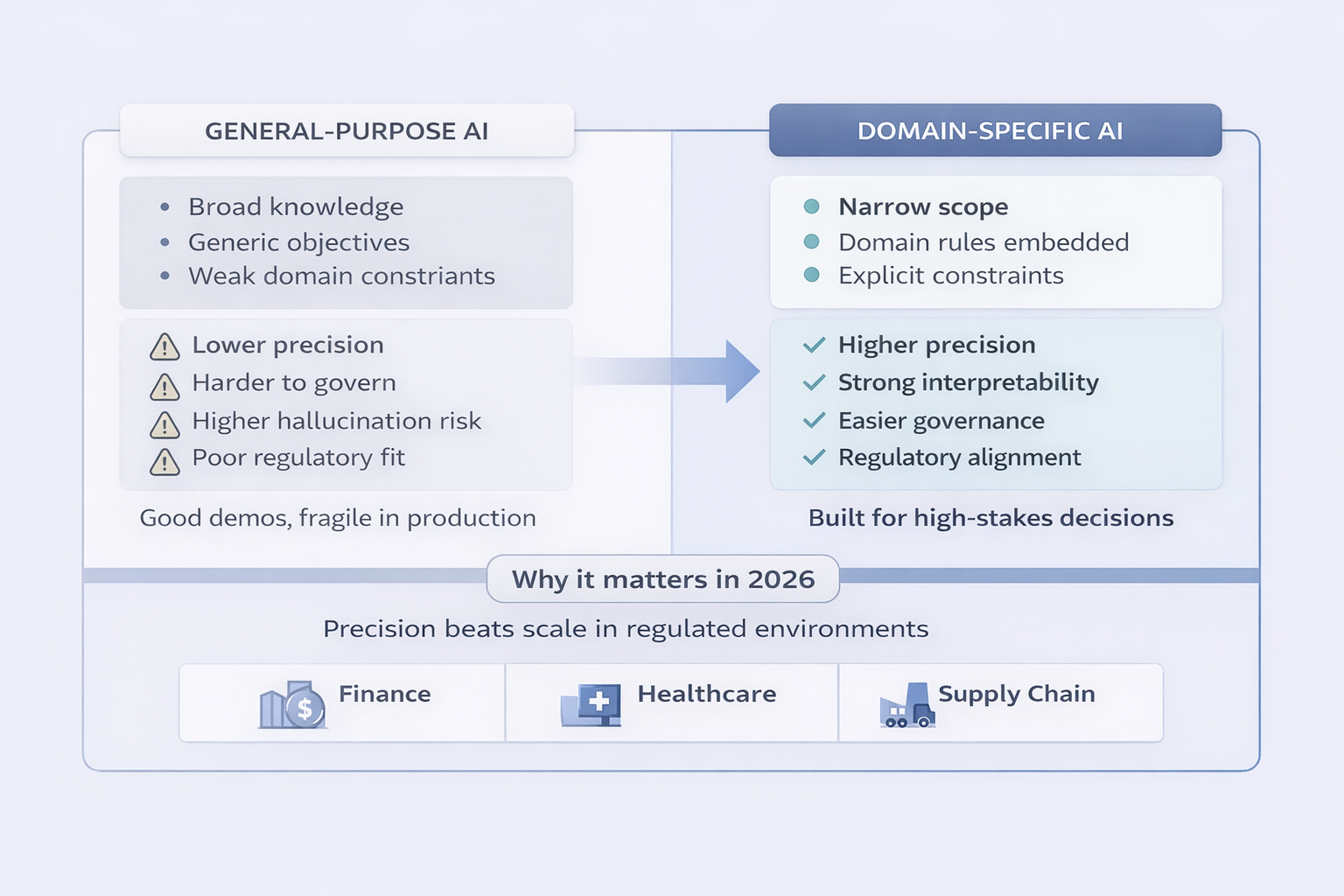
a) Domain-specific AI outperforms general-purpose systems
Broad models struggle with precision in regulated, high-stakes environments. Organizations increasingly deploy AI systems tuned for specific domains finance, healthcare, supply chains where constraints, objectives, and data structures are well-defined.
b) Small language models replace massive foundation models in production
The industry moves away from 70B-parameter models toward small language models (SLMs) under 7B parameters. These models deliver superior performance on narrow tasks, lower latency, reduced cost, and enable on-premise deployment keeping sensitive data inside organizational boundaries.
c) Multimodal AI becomes standard in complex decision environments
Text-only intelligence proves insufficient. In 2026, production AI systems routinely process audio, video, images, tabular data, and text simultaneously. This allows richer situational awareness, such as combining earnings-call audio, financial statements, and market data into a single analytical flow.
d) Reinforced chain-of-thought improves autonomy and reliability
To handle multi-step decisions, organizations adopt reinforcement learning techniques that train models to explicitly structure their reasoning. This improves accuracy, reduces hallucinations, and allows systems to operate with greater autonomy while remaining auditable.
7. The rise of the AI generalist
The replacement narrative fades and the AI-augmented workforce becomes the norm. Organizations expect employees to collaborate with AI, supervise outputs, and make higher-order decisions. Resistance becomes a career limiter.
Highly specialized roles therefore give way to professionals combining domain expertise, data literacy, and AI fluency. The AI generalist becomes one of the most valuable profiles in the org.
8. Continuous learning becomes a leadership obligation
Organizations that don’t provide contextual AI education see adoption stall. Upskilling becomes a core leadership responsibility, not an optional program.
9. Human expertise regains value in B2B industries
As AI floods the market with content and information, trusted human expertise becomes a differentiator - especially in complex B2B buying decisions.
Final Perspective: 2026 Is the Year AI Grows Up
The throughline across these predictions is simple: execution beats ambition. Data foundations, governance, and organizational discipline not model novelty will define winners in 2026.
At The dAIta Solution, we see 2026 as the inflection point where data and AI strategy stops being primarily about technology choices and starts being about operating model transformation how work gets done, how trust is enforced, and how value is measured.

Chuka Christopher Ilochi
Is your organization poised to execute on your data and gain value from AI?
Explore our offerings and acquire an expert partner today.

About The dAIta Solution
The dAIta Solution provides strategic consultancy, process and data mining, analytics, reporting and automation implementation solutions powered by AI that enable organizations to achieve their full potential hidden within the information that they possess. Our proprietary mining and analytics techniques and vendor-agnostic AI and data software streamlines the path to results and facilitates automation of both the analysis of your organization and implementing solutions to weaknesses or growth opportunities identified. Founded by senior consultancy services executives, data scientists and former EY leaders, The dAIta Solution is headquartered in Los Angeles with operations in London, Lagos and Singapore. For more information, please visit thedaitasolution.com.
Latest Resources



Want to see The dAIta Solution in action?
Get in touch now for a free demo of the platform, our products and services